

You want to buy $10 million of stock. How much does the price move against you before you’re done? That question — market impact — is what separates a profitable strategy from an expensive illusion. This post walks through the key models, starting from the simplest intuition and building toward the frameworks that real execution desks use today.
Starting Simple: Crossing the Spread
The most basic form of market impact is mechanical. A market order to buy pays the ask; the mid-price is halfway between bid and ask. So the immediate cost of a single-unit market order is half the bid-ask spread:
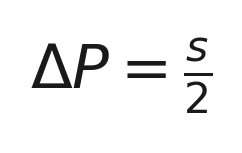
This is the floor — every market order pays at least this much. But most trades are bigger than one unit.
Walking the Book
When your order is large enough to consume all the liquidity at the best price, it starts eating into deeper levels. If ρ(p) is the density of resting limit orders at price p, then the total cost of buying quantity q is an integral over the local book shape:

This captures the mechanical reality: bigger orders consume liquidity at progressively worse prices. But it’s static — it ignores the market’s dynamic response. Real impact persists long after the book refills.
The Central Empirical Fact: The Square-Root Law
Decades of empirical work across equities, futures, FX, and crypto have converged on a remarkably universal result. The price impact of executing a total order of size Q scales as:
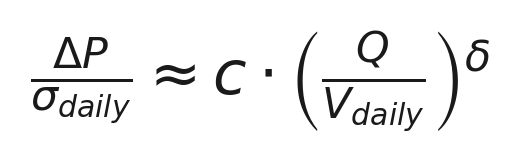
with δ ≈ 0.5 and c of order unity. This holds across markets differing by orders of magnitude in capitalisation, tick size, and microstructure.
Why this matters: doubling your order size does not double your impact — it increases it by √2 ≈ 1.41×. This concavity is why splitting large orders into smaller pieces works, and it’s the foundation of every execution algorithm.
Intuition: if the order book density is roughly uniform near the current price, consuming Q shares requires walking through a price range proportional to Q/ρ. But ρ itself scales with √V in a stationary market, so after normalisation you get ΔP ∝ √(Q/V). An alternative route: dimensional analysis. The only relevant scales are daily volatility σ, daily volume V, and order size Q. The only sub-linear combination with the right units is σ · √(Q/V).
What Happens After You Trade
Temporary vs Permanent Impact
When you finish executing, the price doesn’t stay at the peak. It partially reverts. This motivates splitting impact into two pieces:
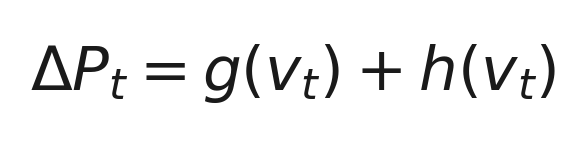
Permanent g(v) — the market’s Bayesian update about fundamental value given the order flow. This never reverts.
Temporary h(v) — the premium for demanding immediacy: consuming liquidity faster than it naturally replenishes. This fades.
Empirically, roughly two-thirds of peak impact persists as permanent, while one-third reverts. You measure this by comparing the price during trading, shortly after, and long after.
Impact Decay Is a Power Law
After execution stops, the price path from peak to permanent impact follows:

where G₀ is peak impact, G∞ is asymptotic permanent impact, and the decay kernel follows a power law:
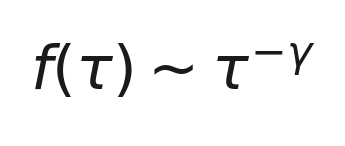
with γ typically between 0.3 and 0.7. The two-thirds rule (G∞/G₀ ≈ 2/3) connects to a deep consistency condition: in an efficient market, permanent impact must equal the expected price move conditional on a buy having occurred.
Theoretical Foundations
Kyle’s Lambda: Why Impact Exists
Kyle (1985) gave the first equilibrium explanation. A market maker faces a mix of informed and noise traders but can’t tell them apart, so she prices linearly in total order flow:
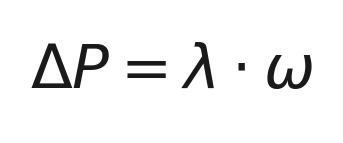
where ω is net signed volume and λ (the Kyle lambda) measures price sensitivity to flow:
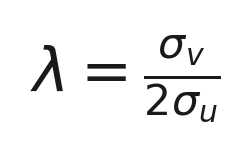
When informed volatility σ_v is high relative to noise σ_u, each unit of flow carries more information and the market maker charges more. Kyle explains why impact exists as an equilibrium phenomenon, but the linear form turns out to be wrong at scale — real impact is concave (square-root), not linear.
The Bouchaud Propagator: Impact Has Memory
Bouchaud et al. proposed a fundamentally different view: impact is neither purely temporary nor purely permanent. The price is a sum over all past trades, each weighted by a propagator G that describes how impact decays:
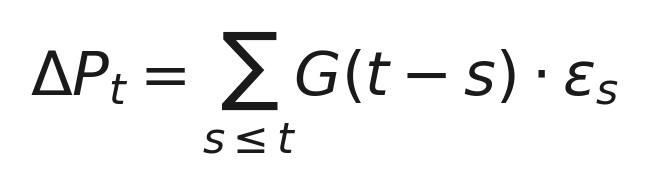
where ε_s is signed volume at time s. If G(τ) is constant, impact is fully permanent. If it’s a delta function, it’s fully temporary. Empirically, neither — it’s a power law:
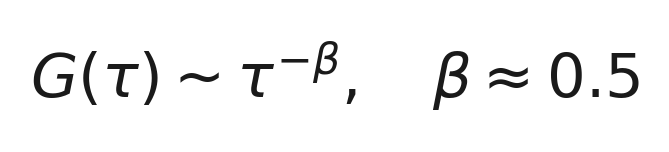
with β ≈ 0.5. This slow decay means the rigid temporary/permanent split is an approximation — in reality there’s a continuous spectrum of decay timescales. The propagator also connects to a deep fact: trade sign autocorrelation decays as τ^{-α} with α ≈ 0.5, and the propagator exactly compensates this to keep prices diffusive.
Optimal Execution: Almgren-Chriss
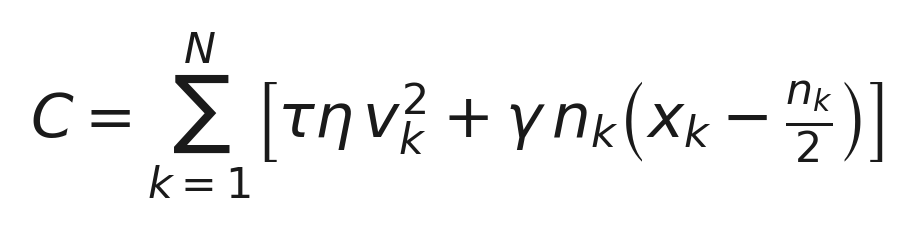
Almgren and Chriss (2000) turned the temporary/permanent decomposition into a practical optimisation. Liquidate X shares over N periods, trading n_k shares in period k at rate v_k = n_k/τ. Total execution cost:
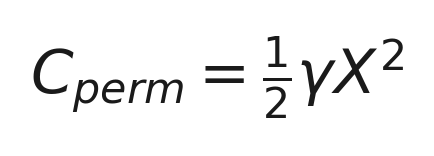
A key result: total permanent cost is strategy-independent. No matter how you schedule the trade:
So the only thing you can optimise is the temporary cost plus a risk penalty:
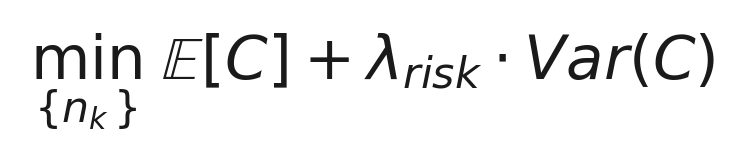
subject to ∑n_k = X. The solution interpolates between TWAP (low risk aversion, minimise temporary cost) and front-loaded aggressive schedules (high risk aversion, minimise variance). The optimal trajectory is a hyperbolic sine, with curvature set by λ_{risk}σ²/η. Almgren-Chriss is the workhorse of institutional execution, though its linear impact assumption doesn’t capture the square-root scaling.
At Scale: Meta-Orders, Cross-Impact, and Latent Liquidity
Meta-Orders: Why Large Orders Are Cheaper Per Unit
A meta-order is the full parent order, split into hundreds of child orders over hours or days. The aggregate impact is concave:

This is a paradox: if each child order has roughly linear impact, aggregate impact should be linear too. The resolution is that the market responds. As a meta-order executes and the price moves, liquidity providers detect the directional flow. New limit orders appear on the impacted side, partially cushioning further impact. Other directional traders may pull back. The concavity is an emergent property of the multi-agent ecosystem, not the static book.
Formally, if each child has impact λ·q but the market recruits liquidity proportional to cumulative displacement:
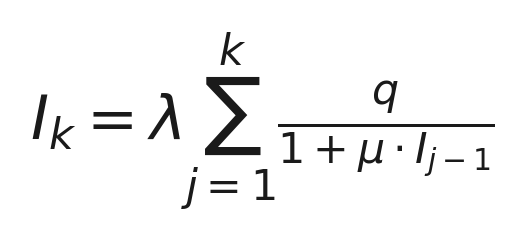
In the continuum limit this recovers I(Q) ∝ Q^{1/2} — the square-root law emerges from a mechanistic agent-response model.
Cross-Impact: Trading One Asset Moves Another
Markets are correlated. Trading asset i moves the price of asset j:
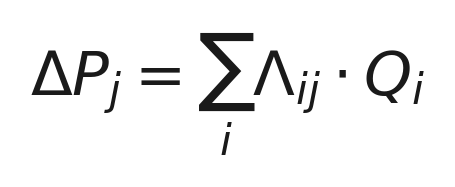
where Λ_{ij} is the cross-impact matrix. It’s not symmetric — trading a liquid large-cap may barely move an illiquid small-cap, but the reverse can be large. The scaling follows the correlation structure:
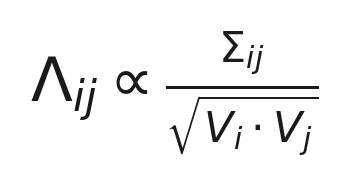
Ignoring cross-impact when executing a correlated basket systematically underestimates costs: selling one asset pushes down all correlated assets before you sell them.
Latent Liquidity: The Hidden Supply Curve
The visible order book is only a fraction of the market’s willingness to trade. Most liquidity is latent — it would appear if the price moved enough. Let S(p) be the cumulative latent supply. The impact of buying Q is just the inverse:
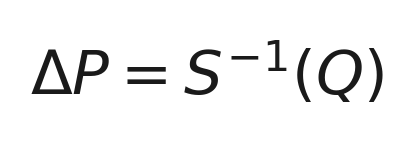
If latent supply increases away from the current price (s(p) ∝ p^α), then:

For α = 1, this gives the square-root law. Latent liquidity explains several puzzles at once: why large orders are absorbed better than visible depth suggests (trading recruits hidden liquidity), why impact is concave (each unit meets increasing latent supply), and why impact partially reverts (once buying stops, recruited sellers withdraw and the price settles back).
Each model corrects the one before it. Spread-crossing ignores dynamics; Kyle adds equilibrium but predicts linear scaling; the square-root law captures the right scaling but has no mechanism; the temporary/permanent split adds time but is rigid; Almgren-Chriss makes it tractable; the propagator frees the temporal structure; cross-impact extends to portfolios; and latent liquidity provides the microeconomic foundation underneath it all.
Modern execution systems operate in the propagator framework, calibrated with cross-impact matrices, layering meta-order concavity and latent liquidity recruitment for realistic cost prediction across asset classes and horizons.
Related Articles
Measuring Market Impact: 24M Trades, Two Exchanges, One Answer — Empirical market impact from 24M crypto trades
Reference Guides - Optimal Execution — TWAP, VWAP, and optimal execution schedules
Reference Guides - Order Book Dynamics — Queue dynamics, price formation, and microstructure
Building a Market-Maker on Hyperliquid — Part I: Theory — The economics of market making and the spread