
The Quantum Trade: A Systematic Portfolio for the Next NVIDIA
19 holdings, 4 sleeves, weekly 20-day MA filter. Sharpe 0.96 net, max drawdown -39%. Tracked live with weekly updates.

$10,000 in NVIDIA in 2016 is worth $1.5 million today. Most investors missed it. Quantum computing is following the same trajectory, but the stocks are 10x more volatile. I built a diversified portfolio across the entire quantum value chain - the pure-play builders, the big tech funders, and the irreplaceable suppliers. 19 stocks, four sleeves, weekly updates. Here's everything.
Almost nobody held NVIDIA through the whole ride. It crashed 66% in 2022. Most retail investors sold. The ones who held made 150x. The lesson wasn't "buy NVIDIA." The lesson was: the investors who got rich were the ones who could survive being wrong for years and still be there when it worked.
Quantum computing is in the same position today. Google's Willow chip achieved verifiable quantum advantage in December 2024. Governments have committed $40+ billion. Every major tech company has a quantum division. The science is no longer theoretical - it's engineering.
But there's a problem the NVIDIA investors never had.
These Stocks Are Untradeable
When Google announced Willow, Rigetti doubled. D-Wave surged 70%. IonQ hit $82. Then Jensen Huang said useful quantum computers are "15 to 30 years away" and in a single day, Rigetti fell 45%, IonQ fell 39%, D-Wave fell 36%. $8 billion in market cap evaporated because one person said one sentence.
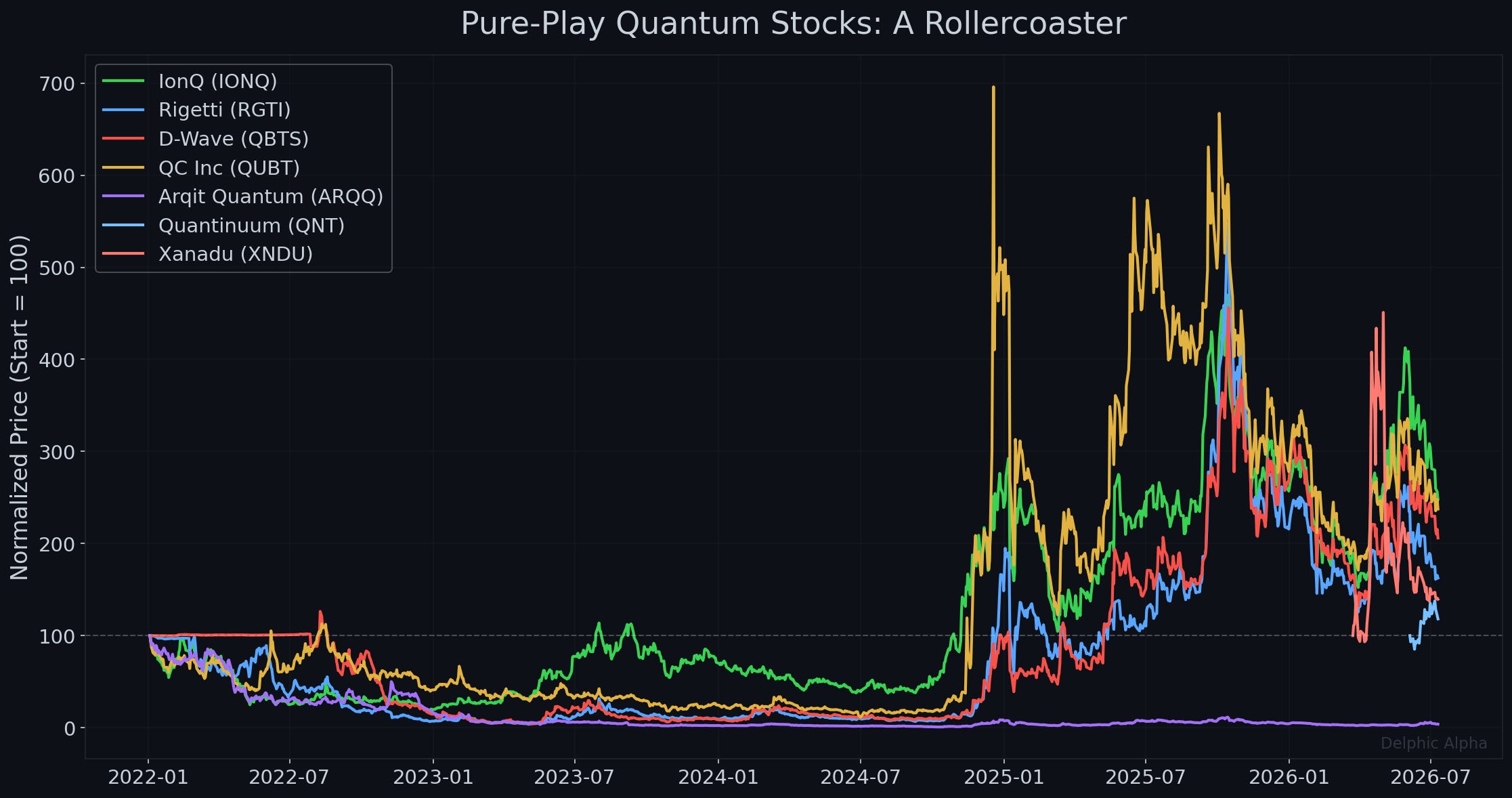
Look at that chart. Every pure-play quantum stock has experienced a drawdown of at least 68%. QUBT hit -90%. Rigetti hit -96%. Arqit fell 99% from its SPAC peak. These stocks move 3-5x the broader market on any given day.
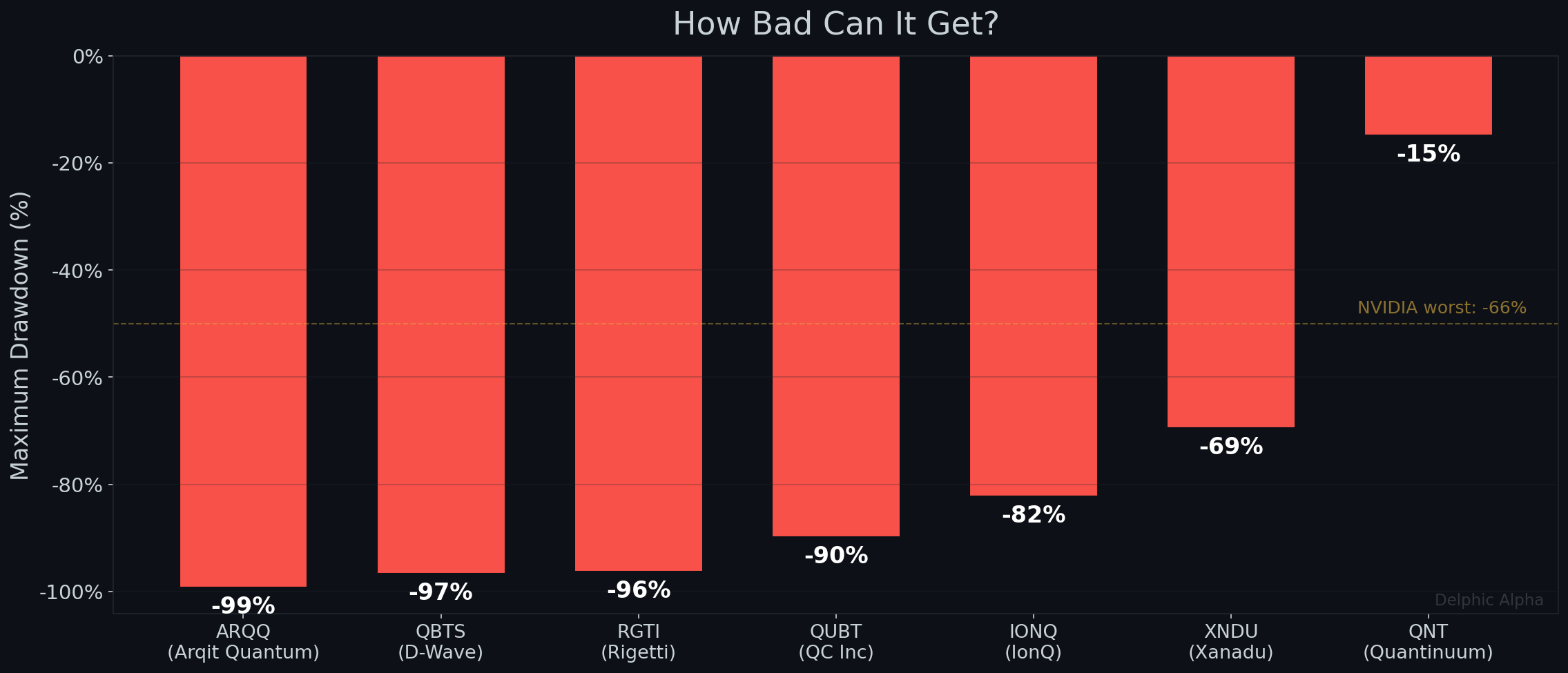
NVIDIA's worst crash was -66% and it had $30 billion in annual revenue to justify holding through it. Quantum stocks have no such floor. Most burn cash. Most trade on narrative. A single conference talk can wipe out months of gains.
Most investors either avoid quantum entirely or buy the pure-plays and sell at the worst possible time. There is a middle path: build a diversified portfolio of companies tied to the quantum computing value chain - the pure-play builders, the big tech companies funding quantum divisions, and the suppliers of the materials and equipment that every quantum computer needs. Spread across the ecosystem so no single company's failure is fatal, and stay positioned for the sector's long-term growth.
I built this portfolio with 19 holdings across four sleeves, backtested it over 4.5 years, and I track it live with weekly updates. The holdings are periodically reviewed as the quantum computing field matures - new companies are added as they IPO, underperformers are removed, and the portfolio evolves as the sector moves from speculative to commercial. Here's everything.
The Quantum Portfolio
Nineteen holdings across four sleeves, with a weekly MA filter on the pure-plays.
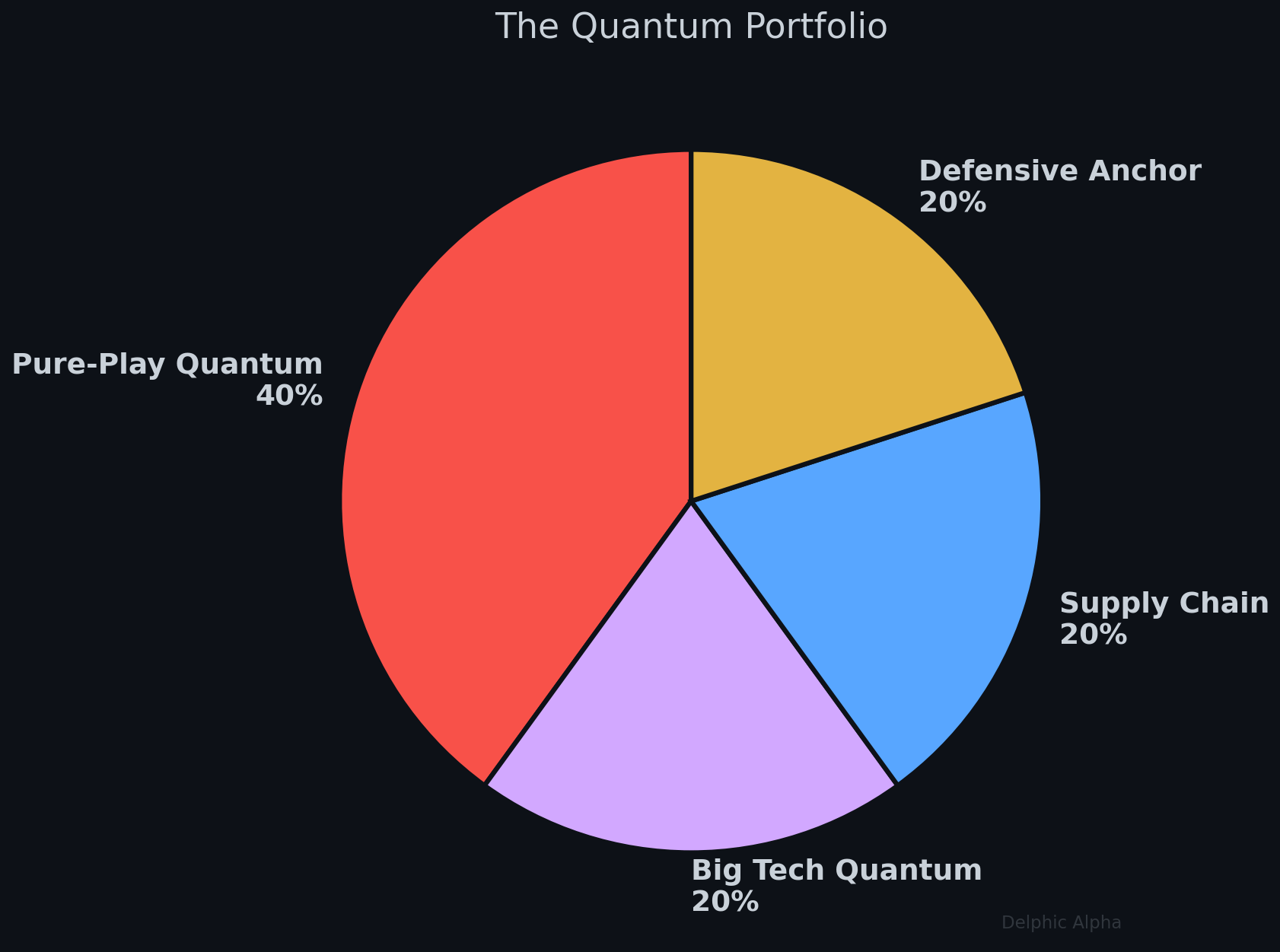
Pure-Play Quantum (40%)
This is the core. Seven companies whose primary business is building quantum computers. Equal-weighted at ~6% each, with new names added as they IPO.
IonQ (IONQ) - Trapped-ion architecture. Largest pure-play quantum company by market cap and revenue.
Rigetti (RGTI) - Superconducting modular chips. Highest beta, highest upside if superconducting wins.
D-Wave (QBTS) - Quantum annealing. The only company with paying enterprise customers running quantum workloads in production. Specialized for optimization.
Quantum Computing Inc (QUBT) - Photonic and topological approaches. Earliest stage, highest risk.
Arqit Quantum (ARQQ) - Quantum encryption and cybersecurity. If quantum breaks classical encryption, Arqit's quantum key distribution becomes essential infrastructure.
Quantinuum (QNT) - Spun out of Honeywell, IPO'd June 2026. Backed by Honeywell's resources and significant outside investment. Trapped-ion architecture with one of the strongest engineering teams in the industry.
Xanadu (XNDU) - Photonic quantum computing. Listed March 2026. Differentiated approach using light instead of superconductors or ions.
Big Tech Quantum (20%)
Large-cap technology companies with dedicated quantum divisions. These are not quantum bets - they are trillion-dollar companies where quantum is a funded R&D unit with potential for enormous upside. Equal-weighted at 5% each.
Alphabet (GOOGL) - Built the Willow chip that achieved quantum supremacy.
IBM (IBM) - Multi-billion dollar commitment to quantum. Heron processor leads the industry. $1 billion in CHIPS Act funding for a quantum data center in Poughkeepsie.
Microsoft (MSFT) - Azure Quantum platform. Topological qubit research and the largest cloud quantum marketplace.
Honeywell (HON) - Parent company of Quantinuum. Retains significant quantum IP and investment upside.
Supply Chain (20%)
Every quantum computer, regardless of architecture, needs the same physical infrastructure: extreme cooling, precision lasers, RF control electronics, and semiconductor fabrication. These companies are the bottleneck. You cannot build a quantum computer without them, and there are no substitutes. Equal-weighted at 4% each.
Keysight (KEYS) - Qubit control electronics. Quantum processors need microwave control signals with picosecond timing. Keysight is the industry standard.
Linde (LIN) - Helium supply. Dilution refrigerators run at 15 millikelvin and need helium. Linde controls a dominant share of global supply. No synthetic alternative exists.
Coherent (COHR) - Precision lasers for trapped-ion and neutral-atom quantum computers. NVIDIA has invested heavily in photonics infrastructure.
FormFactor (FORM) - Cryogenic test equipment. Every quantum chip must be tested at millikelvin temperatures before production. FormFactor is the market leader.
GlobalFoundries (GFS) - Quantum chip fabrication. Specialty processes (silicon-germanium, silicon photonics, RF) serve multiple quantum architectures.
Defensive Anchor (20%)
Why not bonds and gold? Because I checked. On the 32 worst quantum days (bottom 5%), bonds averaged -0.05% and gold averaged -0.75%. Gold actually falls when quantum crashes. Quantum crashes are speculative tech selloffs, not macro events. The assets that hold up are boring defensive equities with zero correlation to quantum sentiment.
Utilities (XLU) ~7% - Essentially flat on quantum crash days. Data centers and quantum computers both need power.
Consumer Staples (XLP) ~7% - The only sector that averaged positive returns on quantum crash days.
US Dollar (UUP) ~7% - Averaged +0.15% on crash days. When speculative assets sell off, money flows into dollars.
The 20-Day MA Filter
A portfolio with 40% in quantum pure-plays will be volatile. The base portfolio has a maximum drawdown of -54%. That's too much for most people.
The fix is simple. Every Sunday, check whether each pure-play stock's previous Friday close is above or below its 20-day moving average. If it's below, shift that stock's weight to the defensive sleeve. If it's above, hold it normally.
Weekly rebalancing strikes the right balance. Monthly is too slow - you can bleed for weeks before the filter reacts. Daily adds cost without much benefit. Weekly catches breakdowns within days and keeps transaction costs manageable.
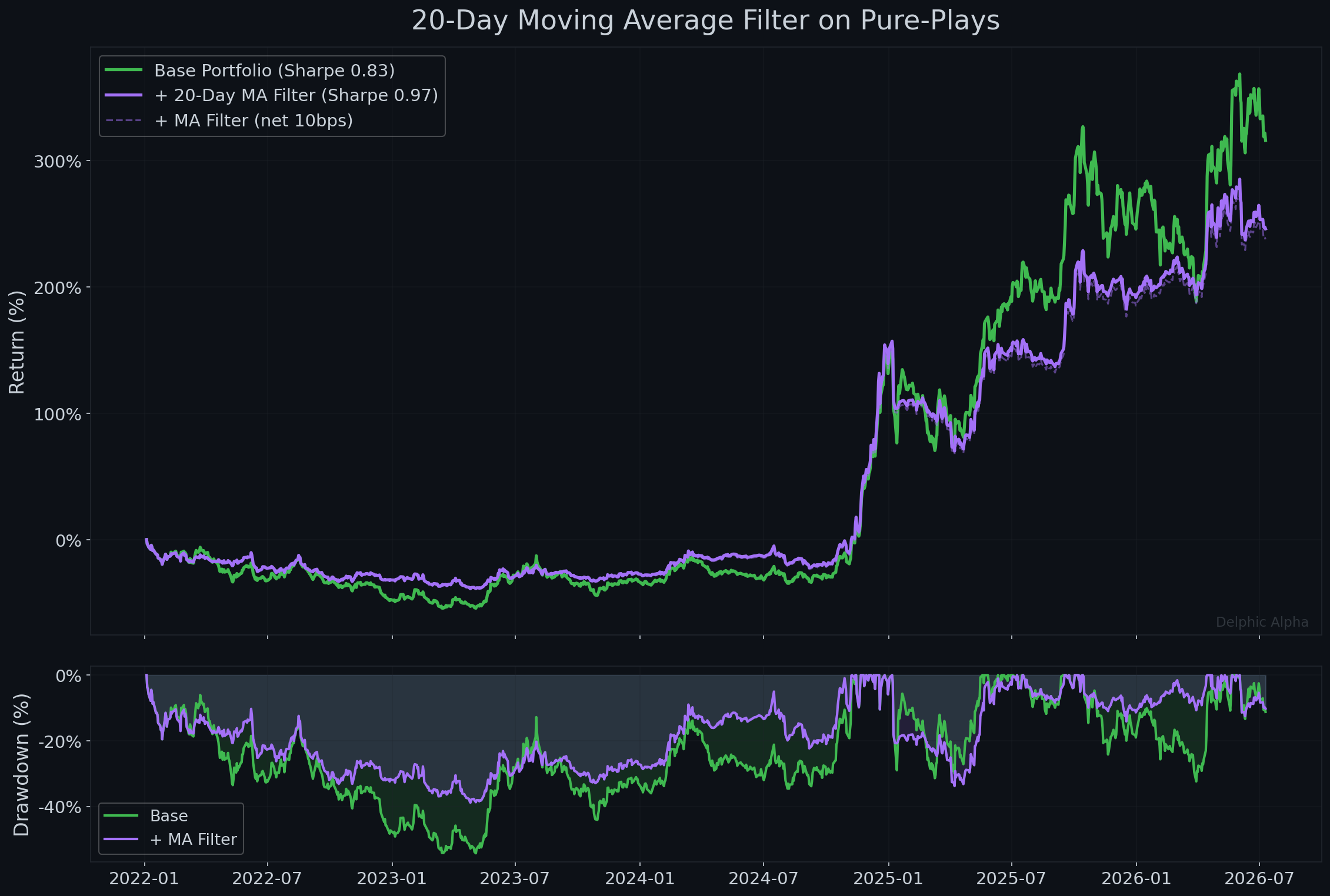
The results:
Sharpe ratio improves from 0.84 to 0.98 (0.96 net of costs) - a 17% improvement in risk-adjusted returns
Maximum drawdown improves from -54% to -39% - 15 percentage points of drawdown avoided
Volatility drops from 45% to 33%
The filter activated in 189 out of 236 weeks - at least one pure-play was below its MA 80% of the time
The trade-off is return: the filtered portfolio returned 32% annualized (gross) versus 38% for the unfiltered base. You give up 6% per year for a 15-point reduction in maximum drawdown. For most people, that's a good trade.
Net of estimated transaction costs (10bps round-trip per rebalance), the filtered portfolio delivers 31% annualized with a Sharpe of 0.96. Annual turnover is roughly 542% and estimated annual costs are about 54 basis points - well under 1% per year.
Quarterly Returns
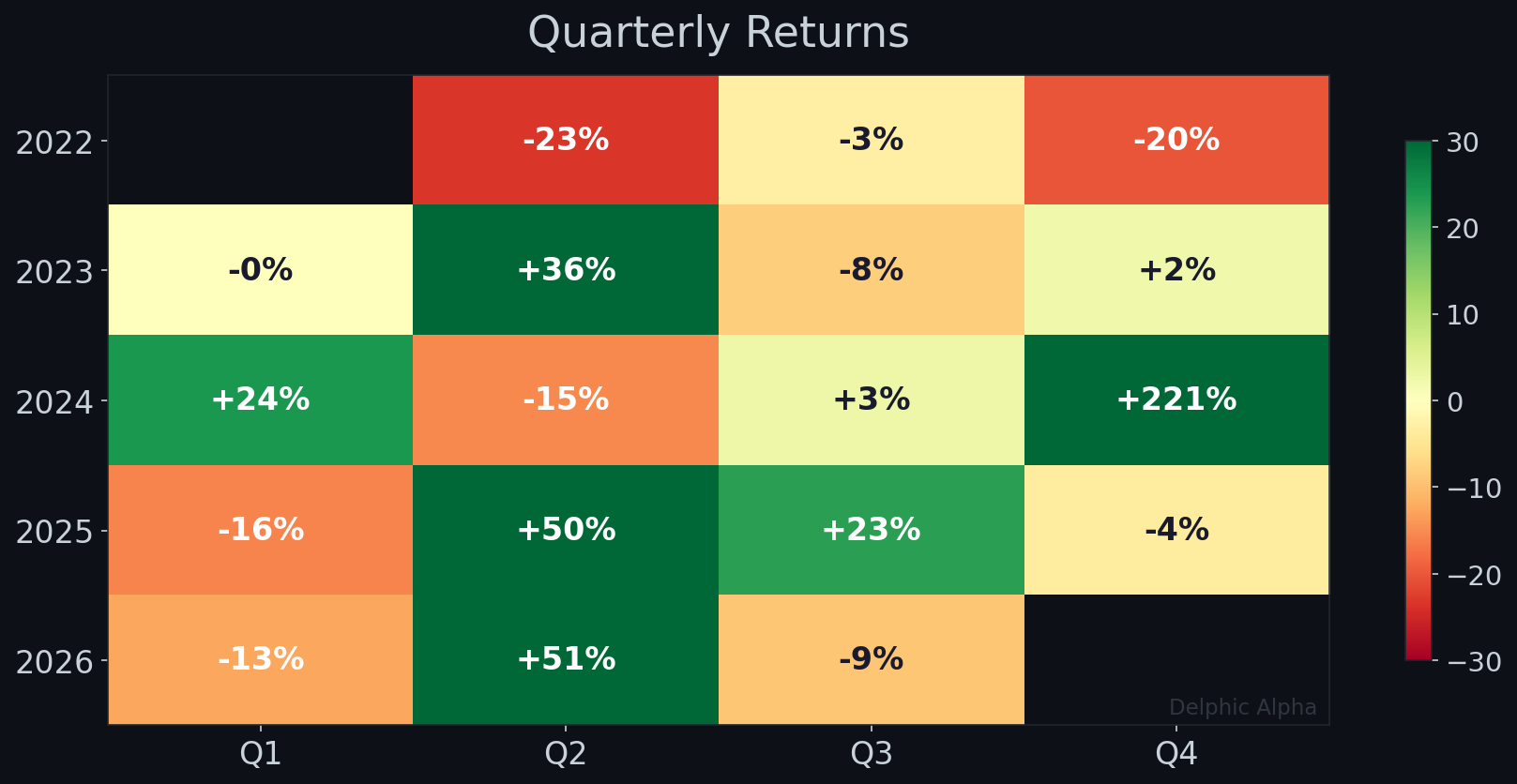
2022 was brutal - the quantum bear market produced multiple negative quarters. Since Q4 2024, the picture has been overwhelmingly green, driven by the Willow announcement and the broader quantum rally.
Risks and How the Portfolio Handles Them
Quantum computing could take longer than expected. That's why 60% of the portfolio is in big tech, supply chain, and defensives - companies with real earnings that don't depend on quantum arriving on schedule. The 40% in pure-plays is where the risk lives, and the MA filter systematically reduces exposure when those names are falling. In the 2022-2023 quantum bear market, the filter cut the drawdown from -54% to -39%.
Individual pure-plays could fail. That's why no single name exceeds 6%, and the portfolio adds new entrants (like Quantinuum and Xanadu) as they list. Diversification across seven pure-plays and five hardware architectures means no single company's failure is catastrophic.
The Milestones That Take This Portfolio to the Sky
Quantum computing is a sequence of technical milestones, each of which reprices the entire sector. The portfolio is designed so you are already positioned when any of them hit.
Logical qubit demonstration (2026-2027). The first fault-tolerant logical qubit - built from many physical qubits with error correction - separates toy demos from useful computation. Google and IBM both target this timeline. This is the Willow moment times ten.
Quantum advantage on a real problem (2027-2028). The first pharma company or bank to announce production results from a quantum computer shifts the TAM narrative from theoretical to measurable. Supply chain demand jumps from research budgets to enterprise procurement.
Government contracts (2026-2028). $40+ billion committed globally. When procurement flows, pure-play revenue shifts from "maybe someday" to contracted backlog. ARQQ and QNT are positioned for defense cybersecurity specifically.
1,000+ logical qubit machine (2029-2031). Google's end-of-decade target. At this scale, quantum simulates molecules for drug discovery, optimizes logistics, and begins threatening current encryption. Supply chain names become bottlenecks with extraordinary pricing power.
Quantum cloud computing (2030+). The endgame. Quantum as a service, like AWS. Pure-plays become the Intels and AMDs of quantum. Supply chain becomes the ASML and TSMC - irreplaceable infrastructure.
Quantum-safe encryption deadline (2030-2035). NIST has already published post-quantum cryptography standards. This is a $50B+ forced upgrade cycle that happens regardless of whether quantum computing becomes broadly useful.
Methodology
Backtest period: January 3, 2022 to July 9, 2026 (1,131 trading days, 236 weekly rebalances). Prices are adjusted for splits and dividends. Weekly rebalancing on the first trading day of each week using the previous day's close for MA signal generation (no look-ahead bias). Stocks are added from their earliest available trading date and equal-weighted within their sleeve. Transaction costs estimated at 10 basis points round-trip per rebalance. Net-of-costs results shown alongside gross. Sharpe and Calmar ratios are annualized. The portfolio does not use leverage, margin, shorting, or options.
Disclaimer
This post is for educational and informational purposes only. It is not financial advice. I am not a financial advisor. The stocks mentioned are examples for analysis purposes. Do your own research before making any investment decisions. Past performance does not predict future results. All investments involve risk, including the possible loss of principal.