
Prop Firm Math: What the Rules Actually Demand From Your Strategy
The formulas behind prop firm pass rates, expected value, and position limits — so you can calculate whether a challenge makes sense before paying the fee.

In the previous post, I covered how to measure your trading skill with the Sharpe ratio. This post answers the next question: if you do have an edge, what does a prop firm challenge actually demand from it?
A proprietary trading firm (prop firm) trades its own capital for profit. In the retail prop firm model, you pay a fee to attempt a "challenge": a trial period where you must hit a profit target without breaching loss limits. Pass, and you get a funded account to trade with the firm's money. Fail, and you lose the fee.
Every challenge is the same game: reach a profit target before hitting a loss limit. The rules vary, but the math is universal. This post gives you the tools to evaluate any prop firm challenge, no matter which firm, which rules, which market.
Disclosure: I am not affiliated with any prop firm. No referral links, no sponsorships. This post is purely educational.
The Three Rules Every Challenge Has
Every prop firm challenge boils down to three constraints:
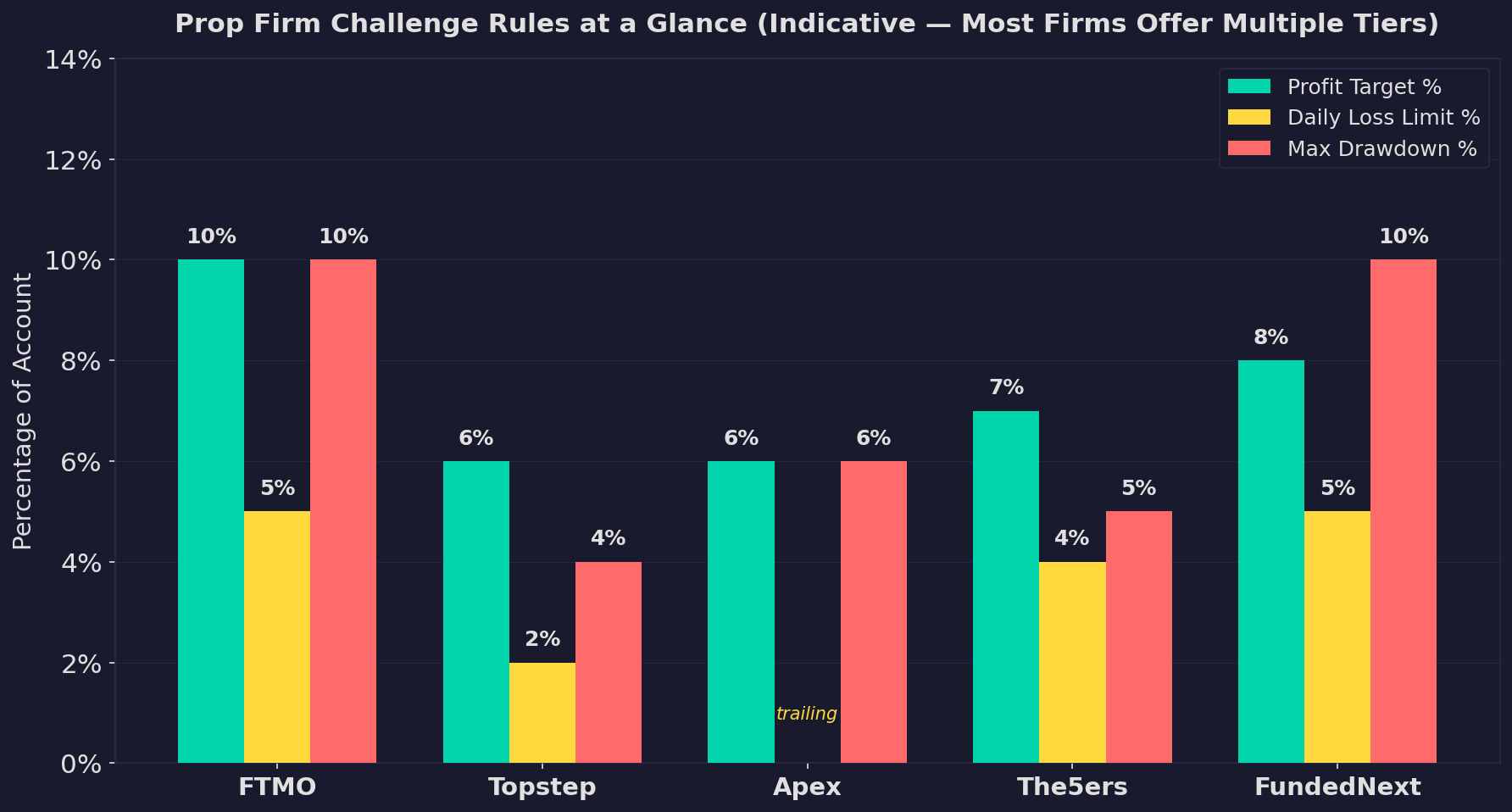
Profit target (T): How much you must make, typically 6-10% of account.
Daily loss limit (L): Maximum you can lose in a single day, typically 2-5%.
Max drawdown (D): Maximum total loss before elimination, typically 4-10%.
Here's how these three numbers vary across the five major firms. The formulas in this post work for any combination.
Step 1: Know Your Numbers
Before any formulas, you need two numbers about your own trading: your average daily return (μ) and your daily volatility (σ). Everything else follows from these.
If you have a track record (50+ trades): calculate your average daily PnL as a percentage of account. That's μ. Calculate the standard deviation of those daily returns. That's σ. Divide μ by σ and multiply by √252 to get your annualized Sharpe. If you did this in Part 1, you already have the number.
If you don't have a track record yet, use the instrument you plan to trade as a guide. Your daily σ is roughly the instrument's daily volatility times your leverage:
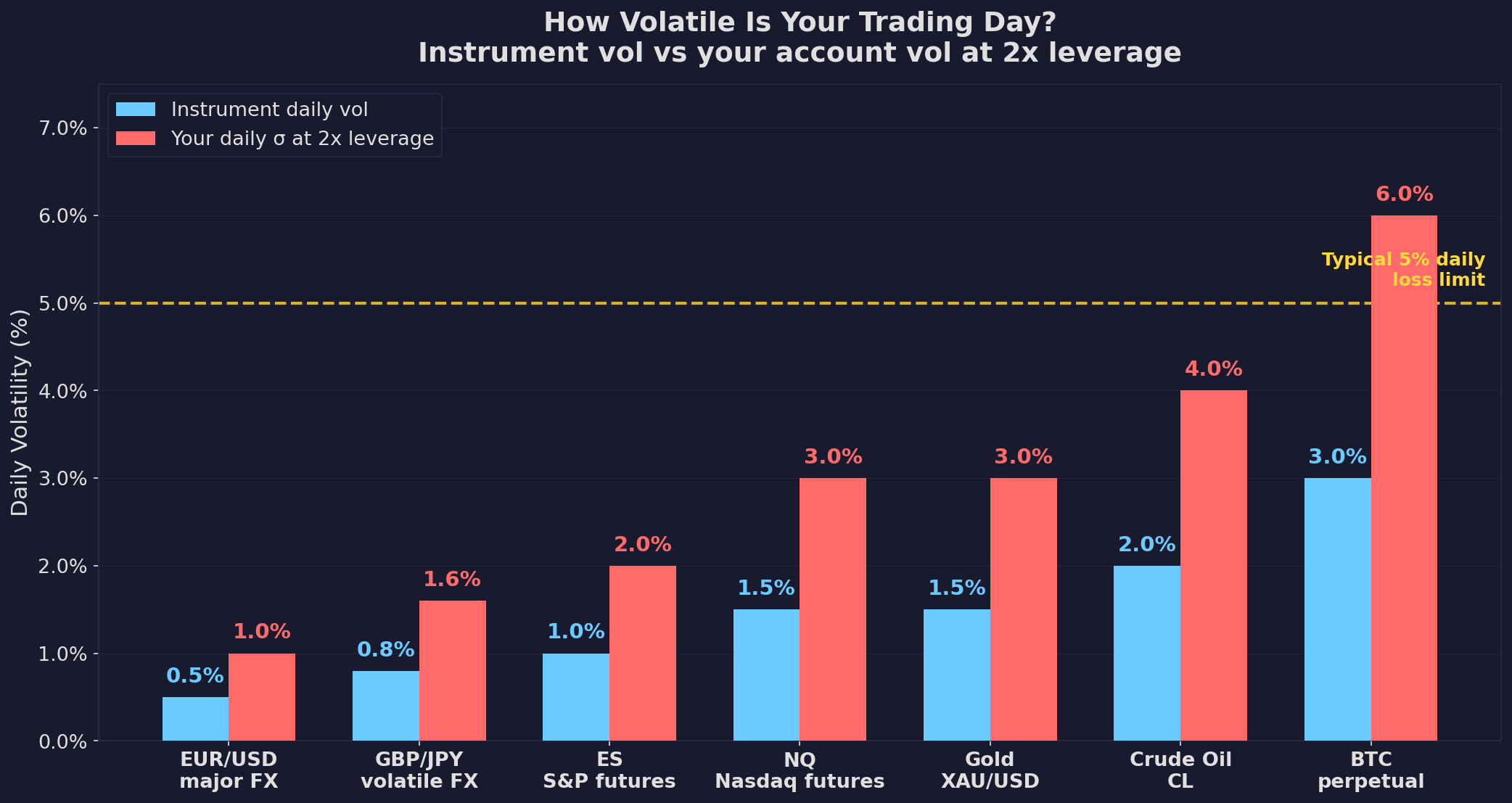
Notice how Crude Oil and BTC at 2x leverage are already near the typical 5% daily loss limit. One bad day and you're out. FX traders have the most room.
For μ, be honest. A day trader making 2-3 round trips in NQ with a slight edge might average +0.05% to +0.15% per day on the account. A swing trader holding FX positions for days might average +0.03% to +0.10%. Most people overestimate their μ and underestimate their σ.
Quick calibration: if you're roughly break-even after 3-6 months of trading, your Sharpe is near zero. If you're up 10-15% over a year with occasional 5% drawdowns, you're around Sharpe 0.5-1.0. If you're consistently making money every month with small drawdowns, you might be Sharpe 1.5+.
Does win rate matter? Not directly. A 40% win rate with 3:1 payoff (big wins, small losses) produces the same Sharpe as a 70% win rate with 0.8:1 payoff (small wins, frequent). The formulas below use μ and σ, which absorb both win rate and payoff ratio into a single number. What does matter is how your wins are distributed. Consistency rules (covered below) penalise strategies that make all their money on a few big days, regardless of overall Sharpe.
Step 2: Your Raw Pass Probability
A prop firm challenge is a classic gambler's ruin problem: start at 0, try to reach +T (profit target) before falling to -D (max drawdown). If your daily PnL is:

then the probability of passing is:

For the common case where target equals drawdown (T = D), this simplifies to a sigmoid:

θ is your "edge-to-noise ratio". It captures how good your strategy is (s), how far you must go (T), and how noisy each day is (σ). Here's what the raw numbers look like for a 10% target / 10% drawdown challenge at daily σ = 1.5%:
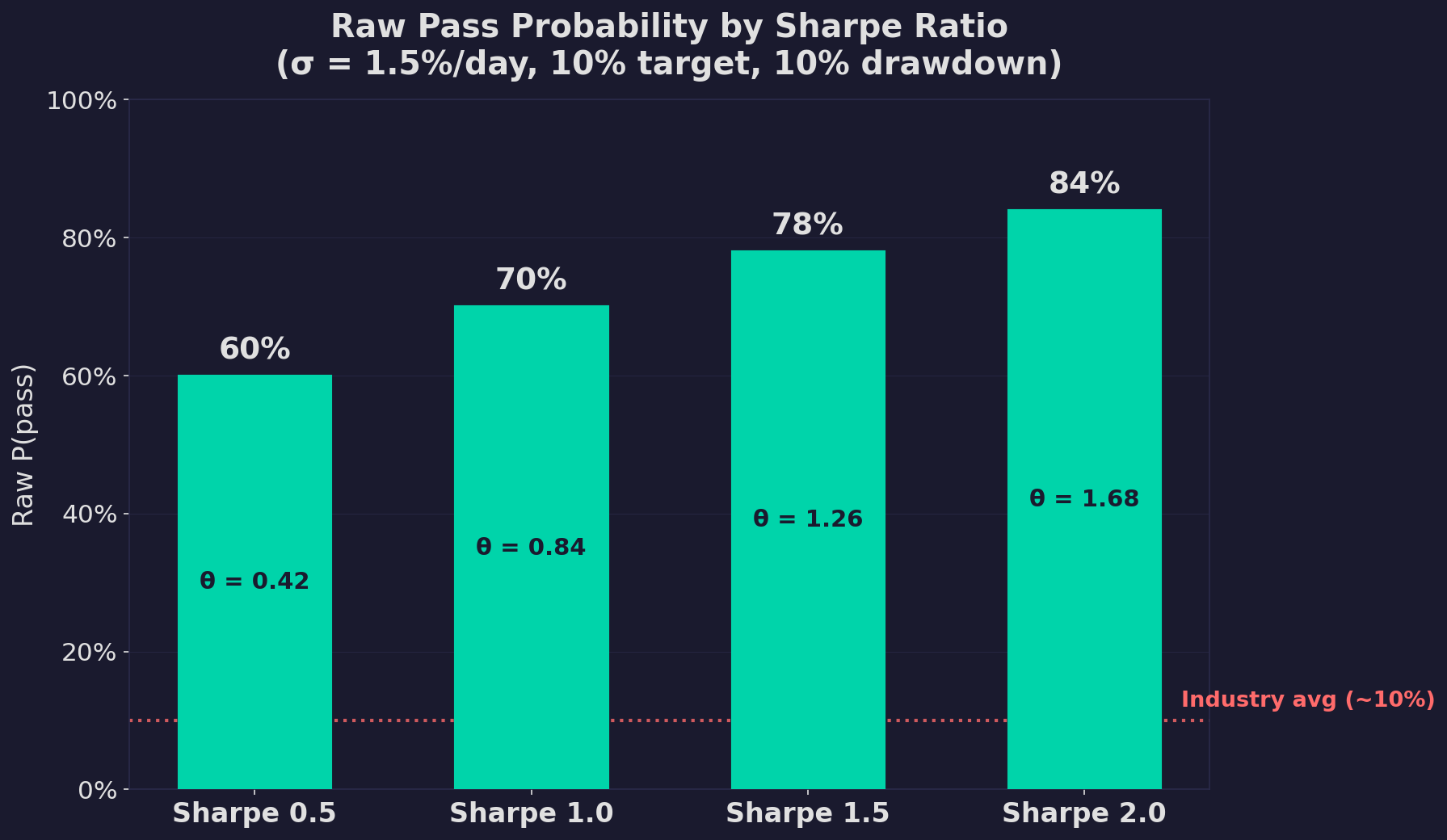
These raw numbers are too optimistic. The industry average pass rate is ~10%, not 60%. The next section explains why.
Quick sanity check, Calmar ratio: divide the profit target by the drawdown limit. That's the minimum Calmar ratio (annualized return / max drawdown) your strategy needs. To pass reliably, you need roughly double that number. A 10% target with 10% drawdown means minimum Calmar 1.0, realistically ≥ 2.0. A challenge with 8% target and 5% drawdown requires minimum 1.6, realistically ≥ 3.0.
Step 3: What Cuts Your Odds
Five real-world factors reduce the theoretical pass rates. Each one acts independently, and they stack.
Daily loss limits cap your position size
Any single day below the limit terminates you instantly. The limit also constrains your leverage: max leverage = daily limit / (2-3 × instrument vol). For NQ (1.5% daily vol) with a 5% limit, that's about 1.7x, or roughly 3 contracts on $100K. BTC at 3% vol caps you below 1x. You can't bet your way to the target.
Trailing drawdown is much harder than static
Static drawdown fixes the floor at starting balance minus D. Trailing drawdown ratchets the floor up with every new peak. Rally to $115K and the floor is now $105K, not $90K. Pull back to $104K and you're eliminated despite being up. Trailing cuts pass rates by 30-40% versus static.
Consistency rules penalise lumpy winners
Some firms cap your best day at 40-50% of total profit. This means you need 5-7 meaningfully profitable days, not one big hit. A trend-following strategy with Sharpe 1.5 can fail this rule, not because it's unprofitable, but because the rules penalise how it makes money.
Time limits add a lottery element
Some firms impose 30-60 day deadlines. Others have no time limit at all. Subscription-based firms charge monthly, creating implicit time pressure even without a deadline. The impact is large:
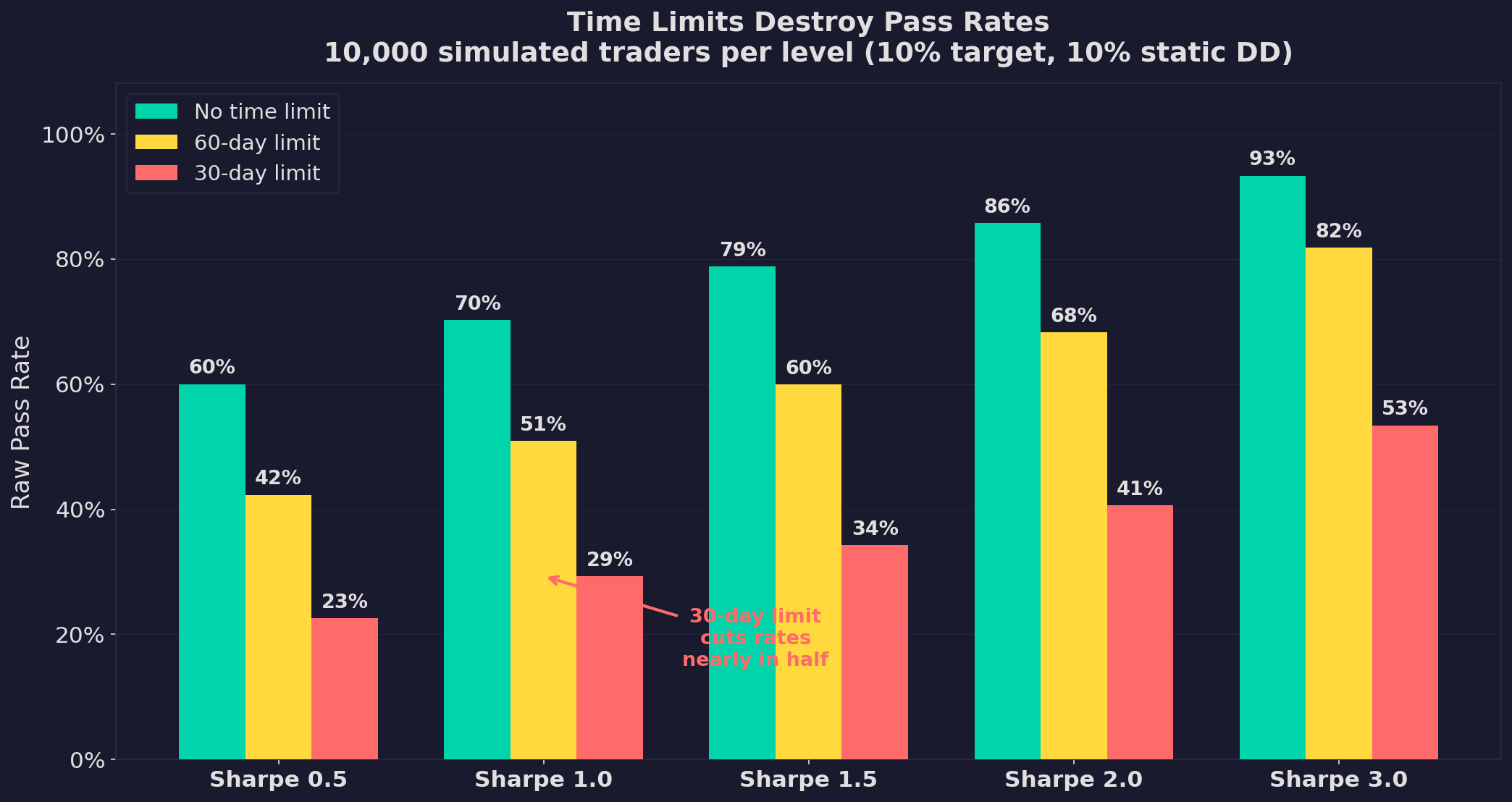
A 30-day limit cuts pass rates nearly in half. At Sharpe 1.0, you drop from 70% (unlimited) to 29% (30 days). The expected time to reach a 10% target at Sharpe 1.0 is ~105 trading days. A 30-day window only gives you ~22 trading days. You need to get lucky, not just be good.
Two-phase challenges multiply the penalty
Some firms require two consecutive passes (e.g. Phase 1: 10% target, Phase 2: 5% target, same drawdown).
P(pass both) = P(Phase 1) × P(Phase 2)
Example (Sharpe 1.5, σ = 1.5%): Phase 1 (T=10%, D=10%): ~55%. Phase 2 (T=5%, D=10%): ~80%. Combined: 0.55 × 0.80 = 44%. Phase 2 is easier (lower target with the same buffer) but the multiplication still hurts. Single-phase firms avoid this penalty entirely.
Putting it all together
How do pass rates change across different challenge configurations? The answer depends on the target, drawdown, and your instrument's volatility.
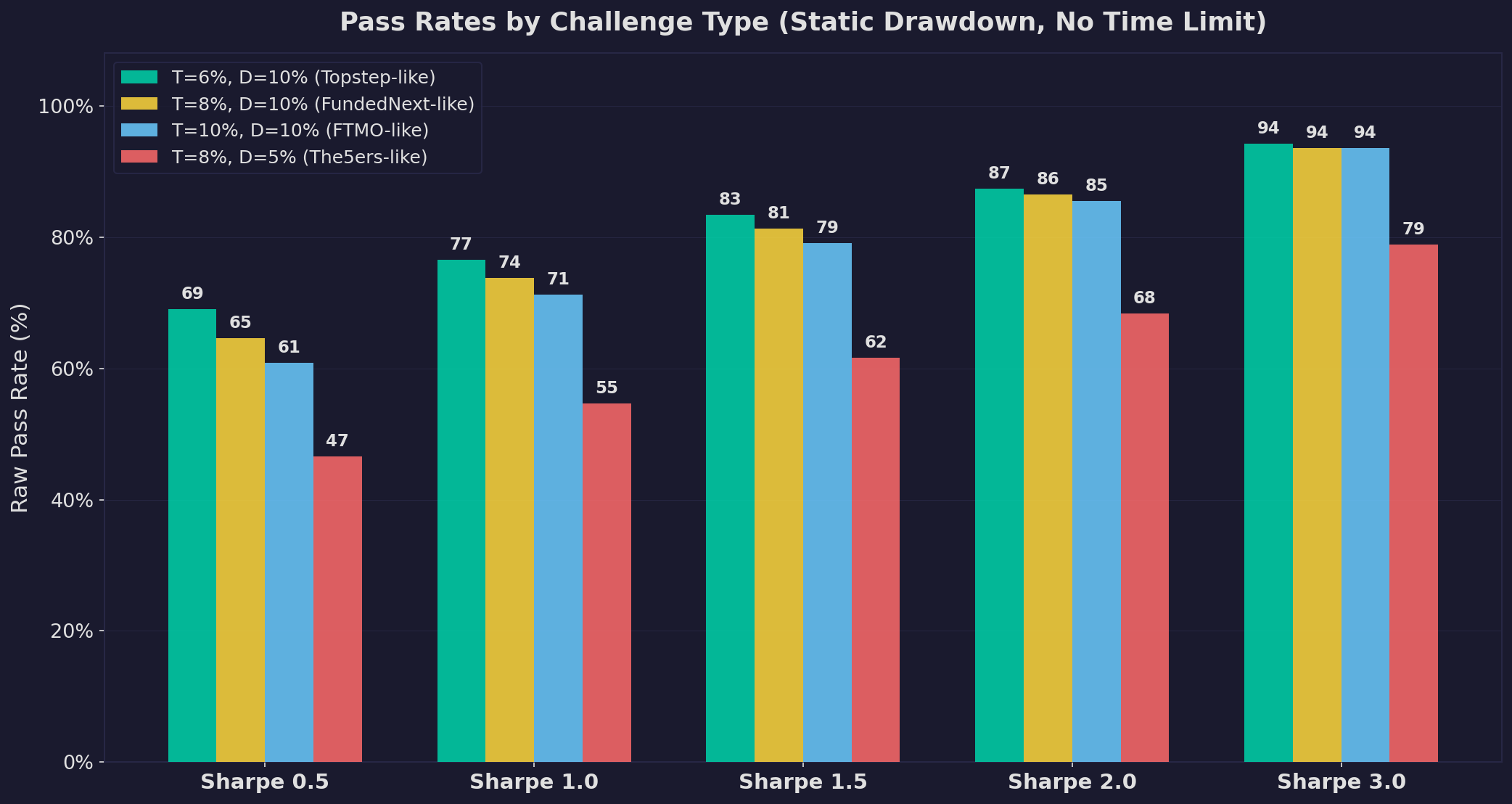
Lower targets are easier (6% vs 10%), and tighter drawdown limits (5% vs 10%) are much harder. The5ers-like setup (T=8%, D=5%) is the hardest challenge at every Sharpe level.
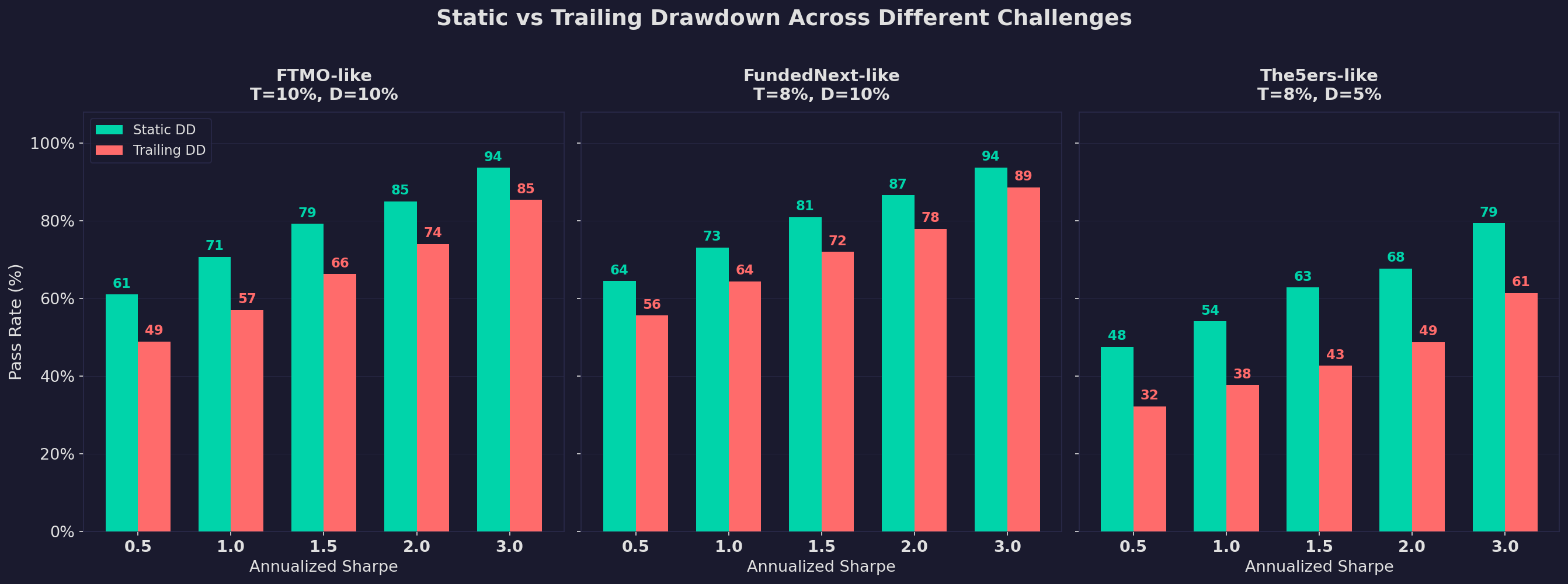
Static vs trailing makes a big difference everywhere, but the gap is largest on tight drawdown limits. On The5ers-like rules (right panel), trailing DD at Sharpe 1.0 drops you from 54% to 38%.
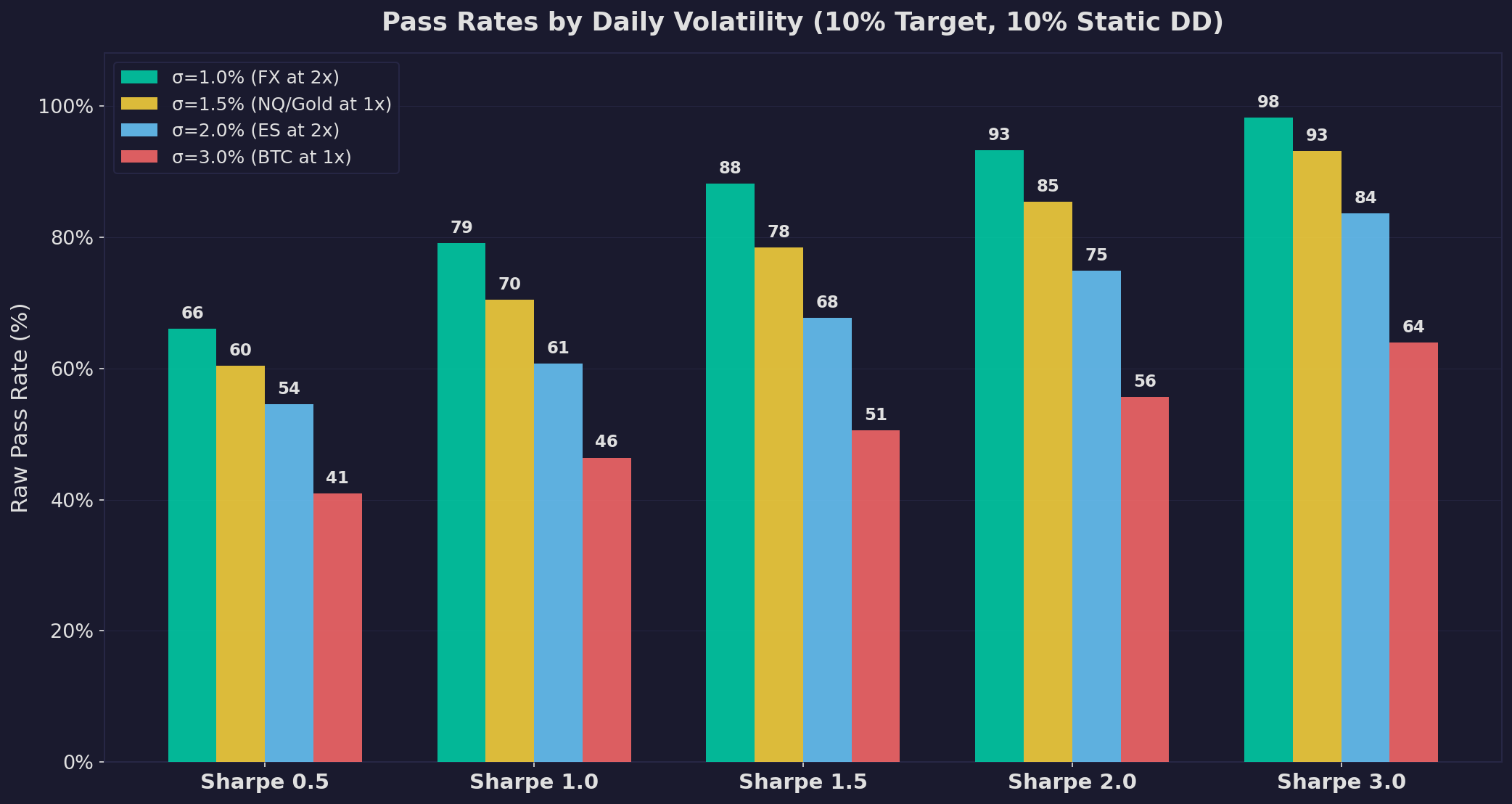
Your instrument matters. FX traders (1% daily vol) have materially higher pass rates than BTC traders (3% daily vol) at the same Sharpe. Lower vol means you're further from the daily loss limit and the drawdown floor on any given day.
After applying all adjustments (daily limits, drawdown type, consistency rules, discrete trading at ~5-10% penalty, and time constraints):
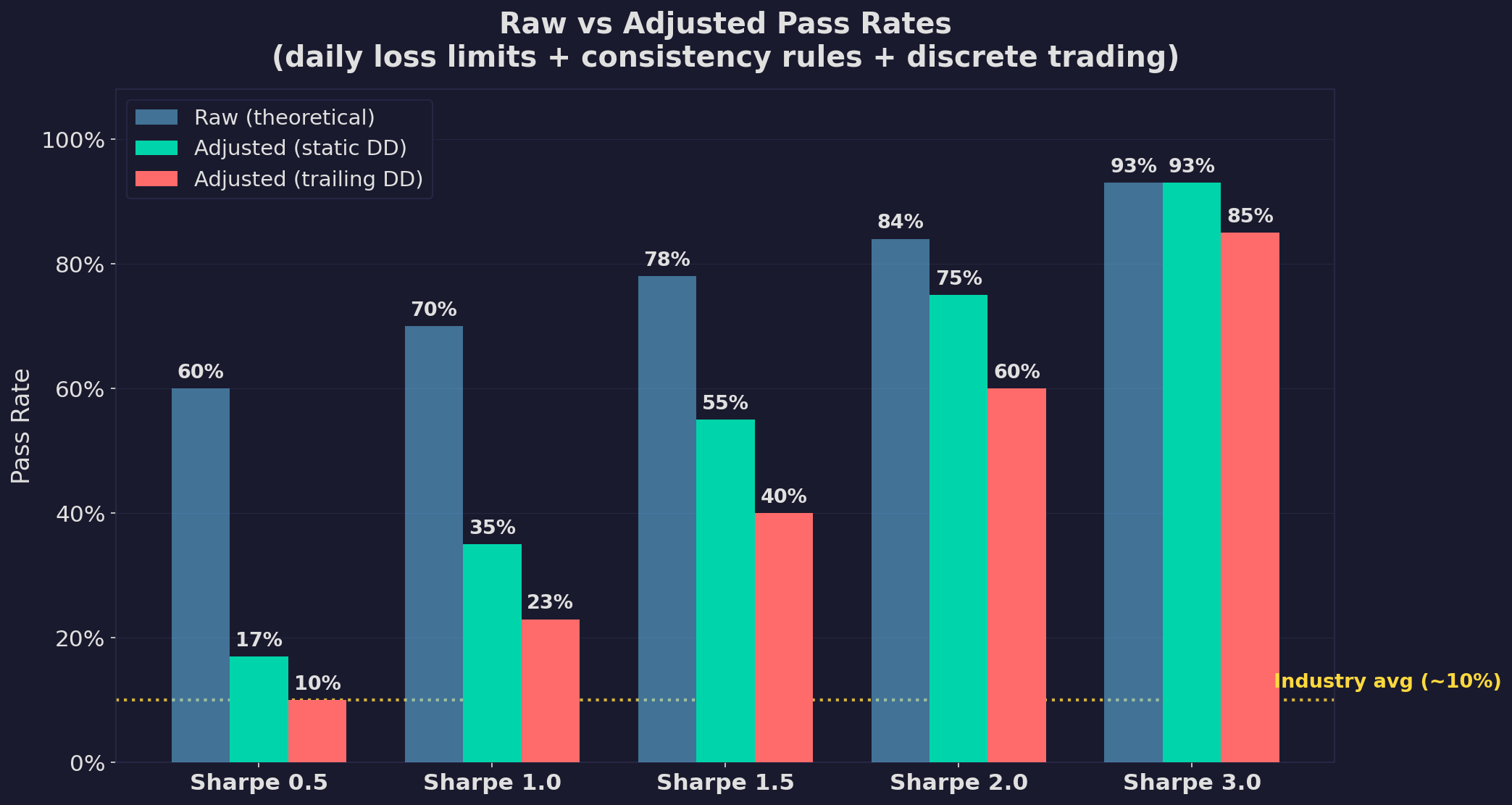
The 10% industry pass rate maps to Sharpe 0.4-0.6. Most challengers have minimal or no edge.
Step 4: Is It Worth the Fee?
The expected value of a single challenge attempt:
EV = P(pass) × P(survive) × Vfunded - Fee
where P(survive) is the probability of surviving to your first payout (~55% within 90 days, based on FTMO's published statistics and aggregated data from trackers such as Prop Firm Match), and Vfunded is what that funded account is worth to you.
Conservative estimate: first payout only
Most funded traders lose their accounts within 90 days. So the realistic baseline is: what's your first payout worth? At Sharpe 1.5, you might make 5% on a $100K funded account over 2-3 months. At 80% profit split, that's $4,000.
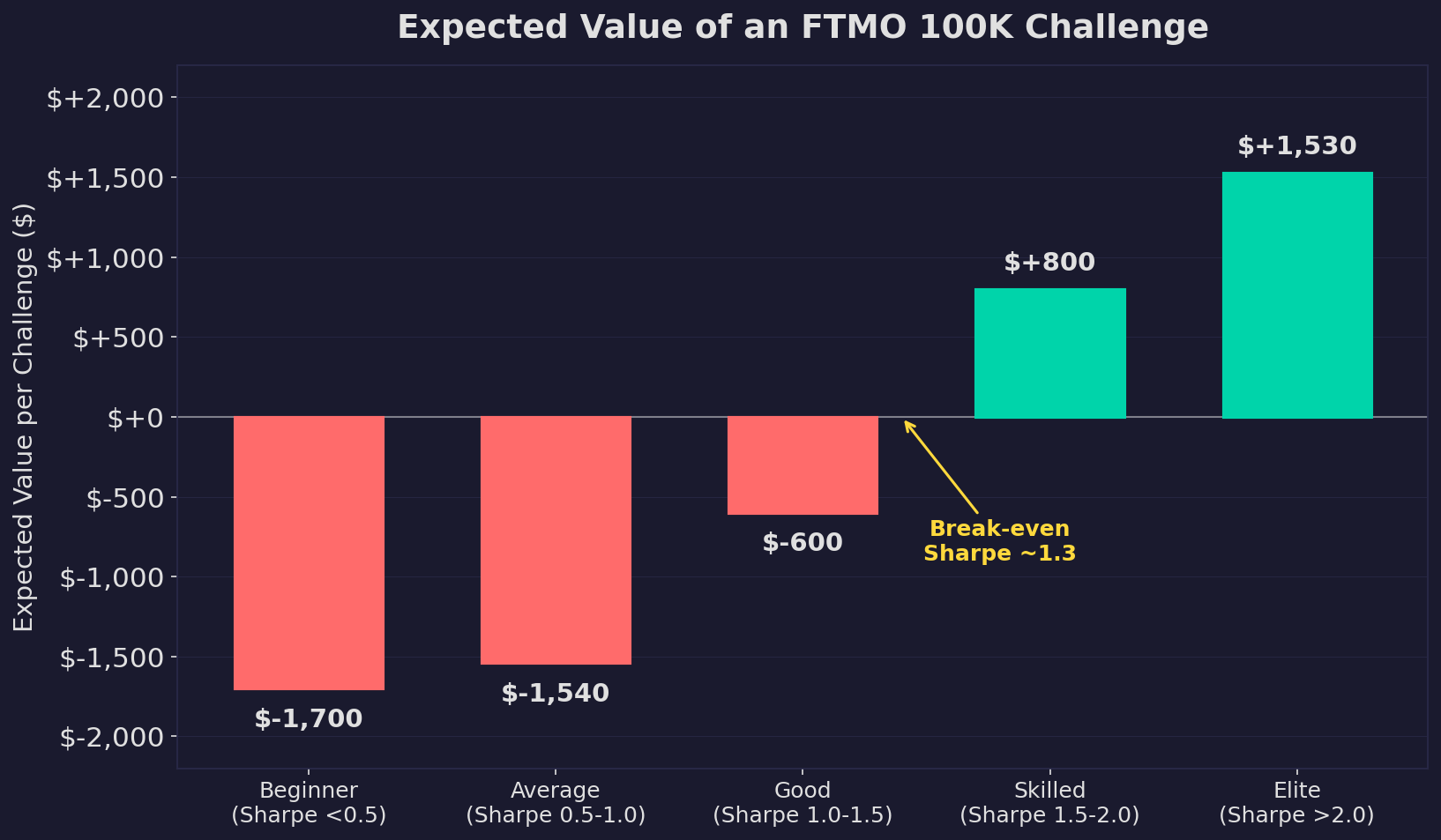
Example: Fee = $580, P(pass) = 44% (FTMO two-phase at Sharpe 1.5), P(survive) = 0.55. EV = 0.44 × 0.55 × $4,000 - $580 = +$388. Barely positive. At Sharpe 1.0, this goes negative.
Setting EV = 0 gives the break-even: Sharpe ~1.3. Below that, every fee is negative expected value.
Optimistic estimate: scaling
If you survive the first 90 days, the economics improve dramatically. Most firms offer account scaling:
The5ers: scales from $100K to $4M with profit split improving from 50% to 100%
FTMO: scales to $400K with split improving from 80% to 90%
Apex: 100% split on first $25K of profit, then 90%
A trader who survives 6+ months on a scaling program might extract $20,000-$50,000+ from a single $580 challenge fee. At that point, the EV is overwhelmingly positive, but only ~20% of funded traders last that long. The scaling opportunity is real but shouldn't be the base case for your decision.
The honest comparison: above Sharpe 2.0, the challenge is clearly +EV even on first-payout math. But at that skill level, $50K of your own capital at moderate leverage compounds faster without a profit split, unless you don't have $50K. That's the real use case: prop firms are leverage for undercapitalised skilled traders.
Summary
Can I pass? Sharpe 0.5: 10-17%. Sharpe 1.5: 40-55%. Sharpe 2.0: 60-75%. Below 0.5, it's a coin flip.
Trailing or static DD? Trailing cuts your pass rate by roughly a third.
Two-phase? Phases multiply: 55% × 80% = 44%.
Min strategy quality? Calmar ≥ 2 × (target / drawdown).
Max position size? Leverage = daily limit / (2-3 × instrument vol). NQ at 5% limit: ~3 contracts on $100K.
Consistency rule? Need 5-7 profitable days if best day capped at 40%. Kills trend following.
Worth the fee? Break-even around Sharpe 1.1-1.5 depending on the firm (1.3 for FTMO, lower for cheaper firms). Below that, every fee is negative EV.
In the next post, I apply all of this to the five major prop firms that survived the 2024-2026 shakeout (FTMO, Topstep, Apex, The5ers, and FundedNext) with firm-specific pass rates, position limits, expected values, a strategy compatibility matrix, and which firms support API access for automated trading.
You mentioned you would be doing a continuation post about strategy compatibility, do you still plan on releasing that? thank you
"$50K of your own capital at moderate leverage compounds faster without a profit split"
True, but that's exactly where systematic trading has an advantage. Scaling through prop firms is mostly operational: in my case, I run a multi-strategy, multi-symbol portfolio inside one EA, so deploying it to prop accounts means using a slightly simplified version of the same system I could trade with personal capital.
So it’s not just about extra buying power. Prop accounts can also act as an incubation layer for portfolio configurations and as a separate capital sleeve with a related, but not identical, equity path.