
Crypto Orderflow Alpha Report — Feb 2026
A systematic evaluation of microstructure-based trading signals on crypto assets.

Crypto Orderflow Alpha Report — Feb 2026
A systematic evaluation of microstructure-based trading signals on crypto assets.
What This Is
This is not a backtest. There are no strategy equity curves, no hypothetical P&L, and no Sharpe ratios built on frictionless assumptions.
Instead, this is an Information Coefficient (IC) analysis — the same approach used by quantitative hedge funds to evaluate whether a signal contains genuine predictive information before committing capital.
For each signal, we measure its correlation with future price changes across multiple timeframes. A positive IC means the signal has directional predictive power. A high t-statistic means that predictive power is statistically significant, not a fluke of the sample.
This month covers 1–28 February 2026 — 1-second order book snapshots across 6 crypto markets.
The Signals
We extract 13 signals from Level 2 order book snapshots at 1-second frequency. Each captures a different dimension of microstructure information.
Imbalance signals — measure the balance of resting liquidity:
Queue Imbalance Top1 — bid vs ask size at the best price
Queue Imbalance Top5 — bid vs ask depth across the top 5 levels
Depth Imbalance Top10 — bid vs ask depth across the top 10 levels
Derived microstructure signals — higher-order features from the book:
Microprice Bias — volume-weighted mid price deviation from the arithmetic mid
Queue Momentum — rate of change of the top-of-book imbalance
Depth Gradient — how imbalance changes between top 5 and top 10 levels
Slope Imbalance — asymmetry of the book's price-depth slope
Order flow signals — measure the dynamics of order arrivals:
OFI (Order Flow Imbalance) — net order flow at the best bid and ask
OFI Rolling 5s — smoothed OFI over a 5-second window
Composite and conditional signals — combinations and filters:
Combined Imbalance — z-score average of queue imbalance and OFI
Contrarian Imbalance — fades extreme queue imbalances (mean reversion)
Adverse Selection — trades based on adverse selection pressure
Spread Timing — trades queue imbalance only when the spread is tight
Data
1–28 February 2026, 1-second order book snapshots across 6 markets:
BTCUSDT Perpetual + Spot (Binance)
ETHUSDT Perpetual + Spot (Binance)
SOLUSDT Perpetual (Binance)
BNBUSDT Perpetual (Binance)
Forward returns computed at six horizons: 10s, 30s, 60s, 120s, 300s, 600s in basis points.
The Hedge Fund Approach to Alpha Analysis
Before a quant fund trades a signal, it runs it through a battery of statistical tests. We apply the same framework:
Information Coefficient (IC) — Pearson correlation between the signal and the subsequent forward return. Measures linear predictive power.
Rank IC — Spearman rank correlation. More robust to outliers and non-linear relationships.
IC t-statistic — statistical significance of the IC across assets. Values above 2.0 suggest the signal is reliably informative, not a sample artifact.
Hit Rate — fraction of observations where the signal direction matches the return direction. Even a 51% hit rate can be enormously profitable at high frequency.
IC Decay Profile — how predictive power changes across forward horizons. Fast decay means the signal is only useful at very short holding periods.
Signal Autocorrelation — how persistent the signal is over time. High autocorrelation means the signal changes slowly (lower turnover); low means it flips rapidly (higher turnover, higher transaction costs).
Signal Correlation Matrix — which signals are redundant and which are independent. Redundant signals don't add diversification value.
1. Information Coefficient
The IC table below shows each signal's predictive power at the 60-second forward return horizon, aggregated across all 6 markets.
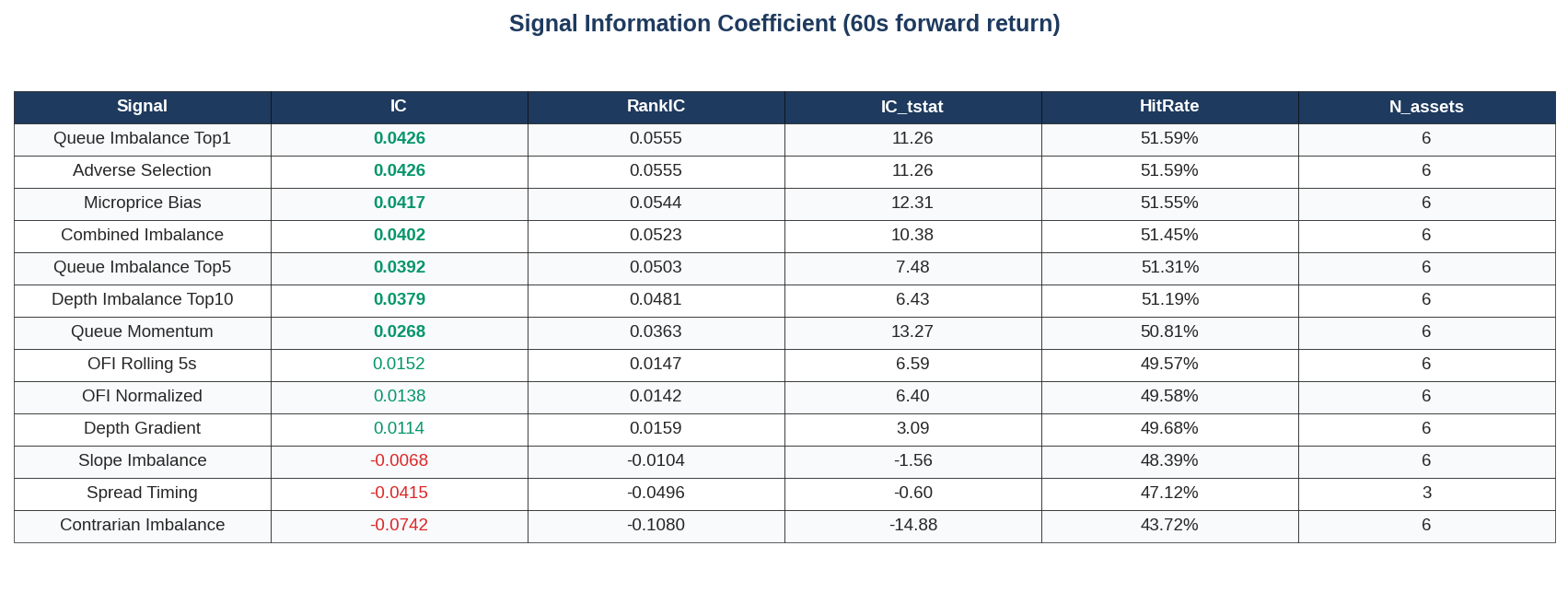
Queue Imbalance Top1 leads with an IC of 0.043 and a t-statistic of 11.3 — comfortably above the 2.0 threshold for statistical significance.
At the other end, Contrarian Imbalance has a negative IC of -0.074 — meaning this contrarian signal actually moves against the subsequent price direction.
11 of 13 signals have a statistically significant IC (|t-stat| > 2.0). Hit rates cluster in the 49–52% range — small edges, but at 86,400 observations per day per asset, even a 51% hit rate is highly significant.
The key takeaway: order book imbalance signals contain genuine short-term predictive information. The effect is small in absolute terms but statistically robust.
2. IC Decay Profile
How quickly does predictive power decay as we look further forward?
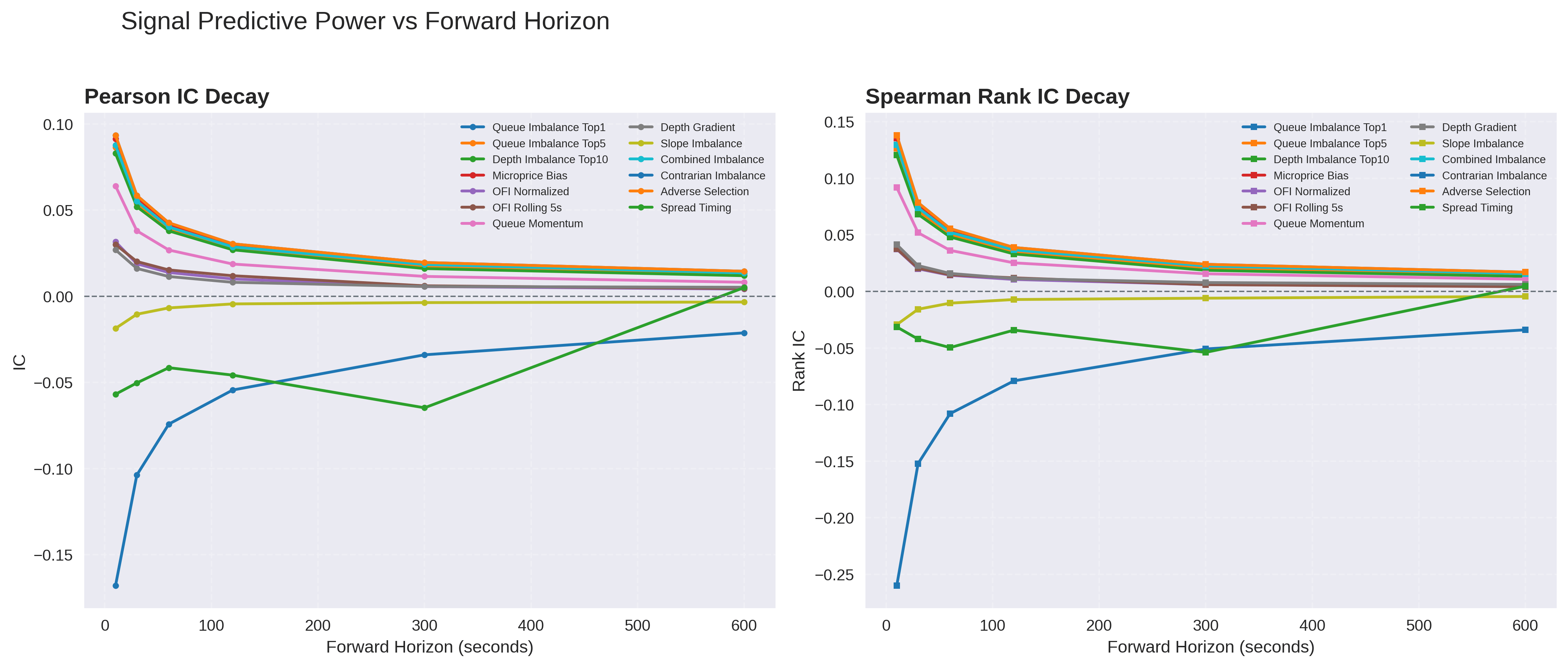
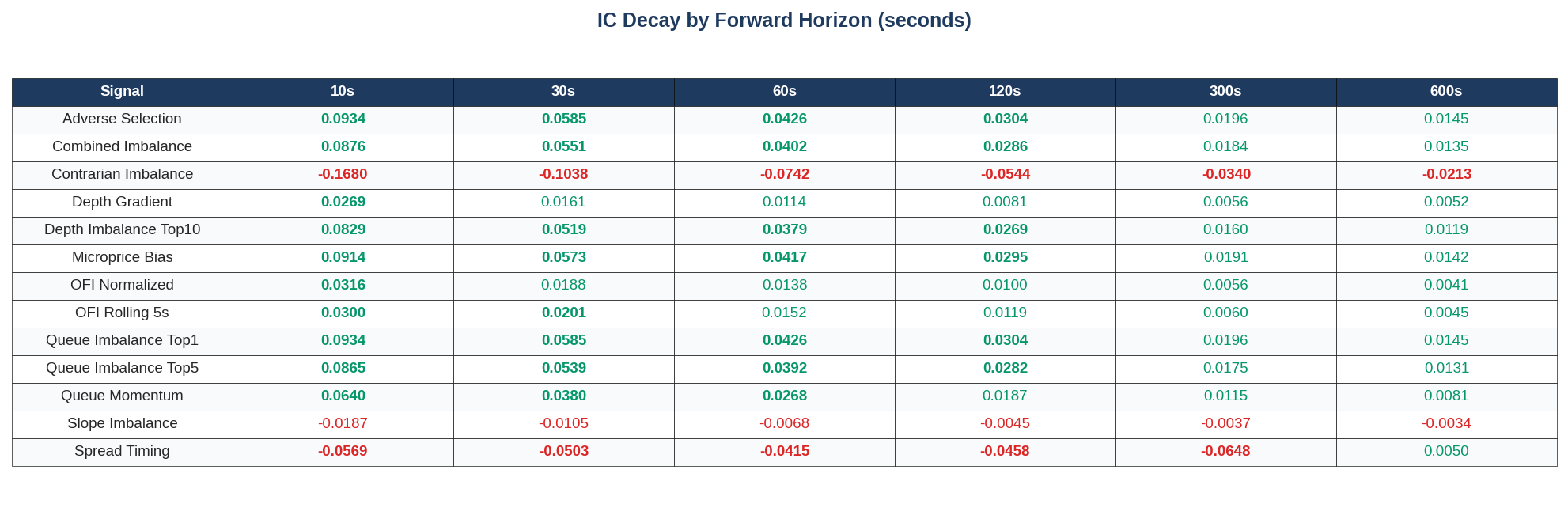
The pattern is clear: imbalance signals peak at the shortest horizons and decay monotonically. This is the signature of genuine microstructure alpha — the information is fleeting and gets priced in quickly.
Queue Imbalance and Microprice Bias signals show the steepest decay — their edge is concentrated in the first 10–60 seconds. OFI-based signals decay more slowly, suggesting they capture a slightly different (and longer-lived) dimension of order flow information.
The Contrarian Imbalance signal is consistently negative across all horizons, confirming that mean reversion of the order book does not predict mean reversion of the price at these timescales.
3. Signal Autocorrelation and Turnover
How persistent are these signals? A signal that flips every second generates enormous transaction costs; one that holds for minutes is cheaper to trade.
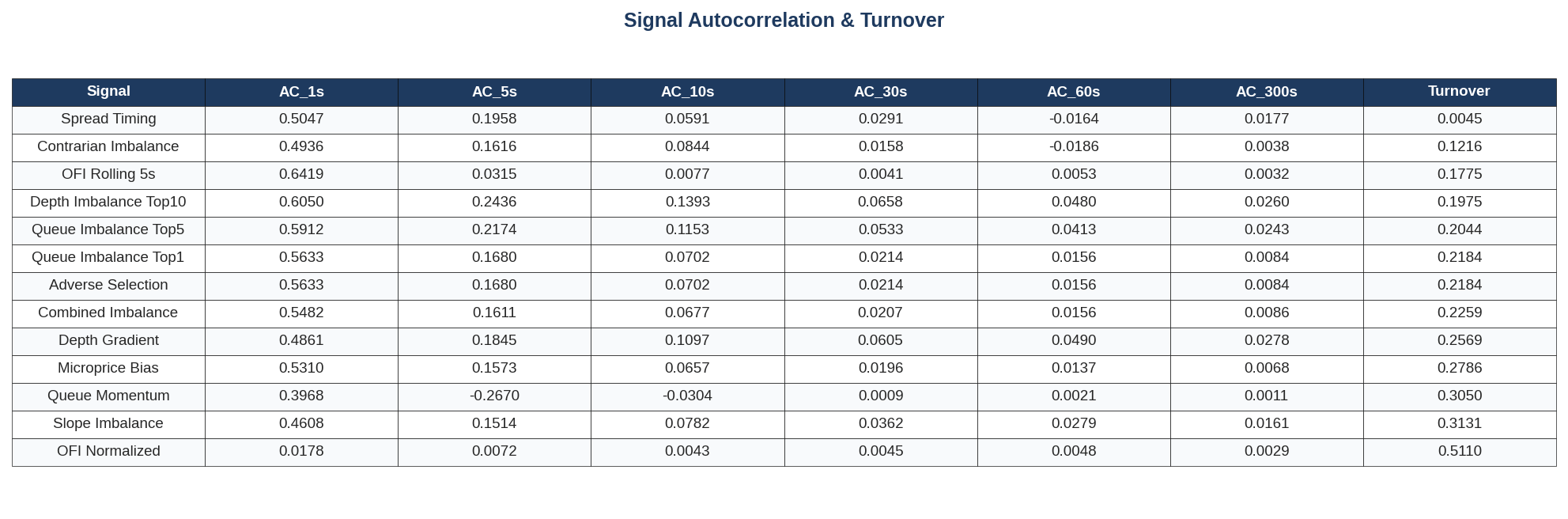
Three tiers emerge:
Most persistent — Depth Imbalance Top10, Queue Imbalance Top5, Slope Imbalance. These have high 1-second autocorrelation (>0.95) and low turnover. The deep book changes slowly.
Moderately persistent — Queue Imbalance Top1, Microprice Bias, Adverse Selection. Still highly autocorrelated but with slightly higher turnover as the top of book is more dynamic.
Least persistent — OFI, OFI Rolling 5s, Queue Momentum. These are flow-based signals that fluctuate rapidly. OFI in particular has high turnover, making it expensive to trade naively.
Spread Timing has near-zero turnover because it only trades when the spread is unusually tight — a rare condition.
4. Signal Correlation Matrix
Which signals are telling us the same thing, and which offer independent information?
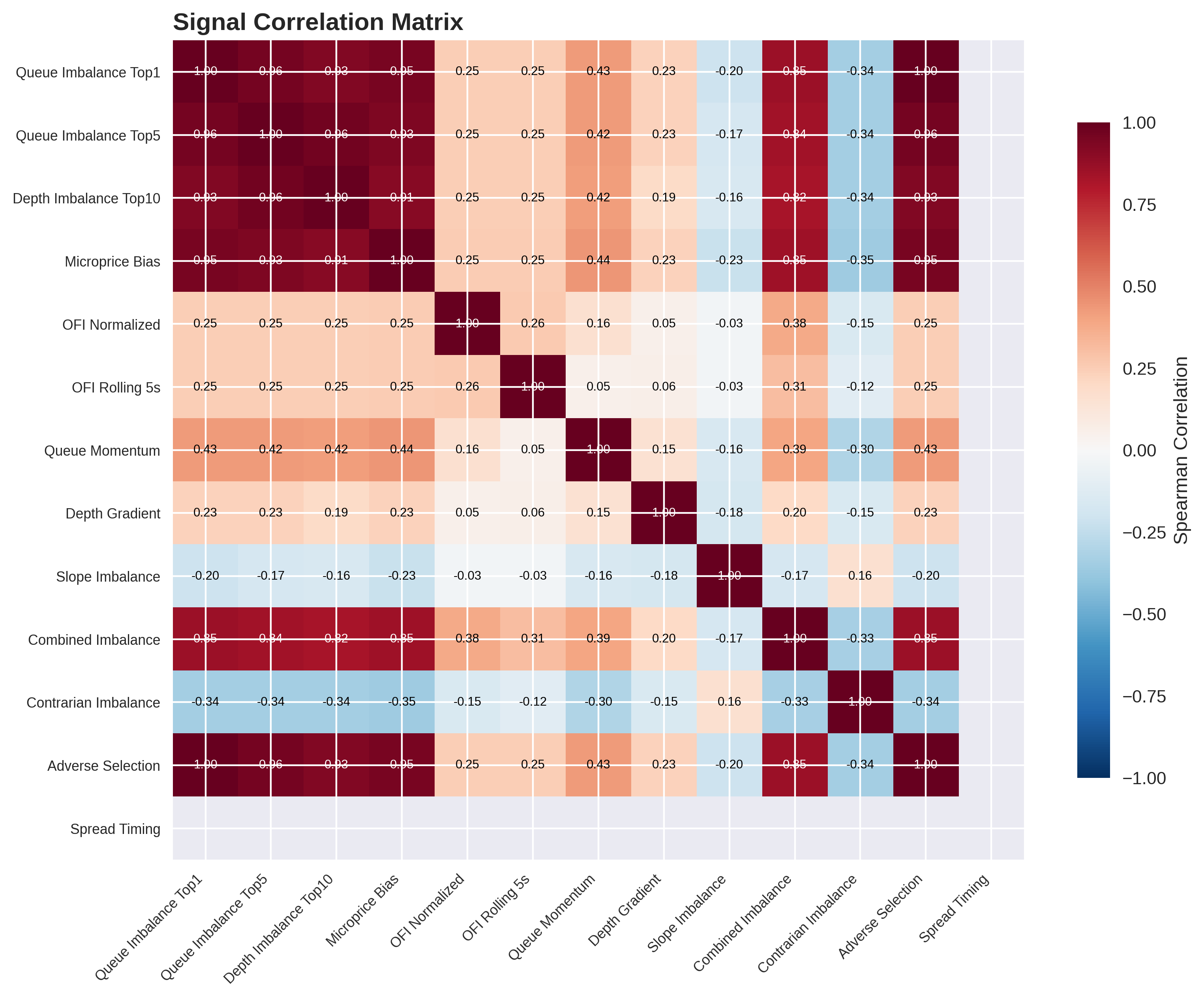
Several clusters emerge:
Imbalance block — Queue Imbalance Top1, Top5, Depth Imbalance Top10, Microprice Bias, and Adverse Selection are all highly correlated (0.7–1.0). They all measure essentially the same thing: the balance of resting limit orders. Adverse Selection has near-perfect correlation with Queue Imbalance Top1 — they are functionally identical signals.
Order flow cluster — OFI and OFI Rolling 5s correlate with each other but have low correlation with the imbalance block. They capture a different source of information: changes in the book rather than its state.
Independent signals — Queue Momentum, Depth Gradient, and Contrarian Imbalance have low correlation with both clusters. These offer genuine diversification if combined in a multi-signal model.
The practical implication: you only need 3–4 signals to capture most of the available information. One imbalance measure, one OFI measure, queue momentum, and optionally a spread filter.
5. Latency Sensitivity
The final test: how fast do you need to be to capture this alpha?
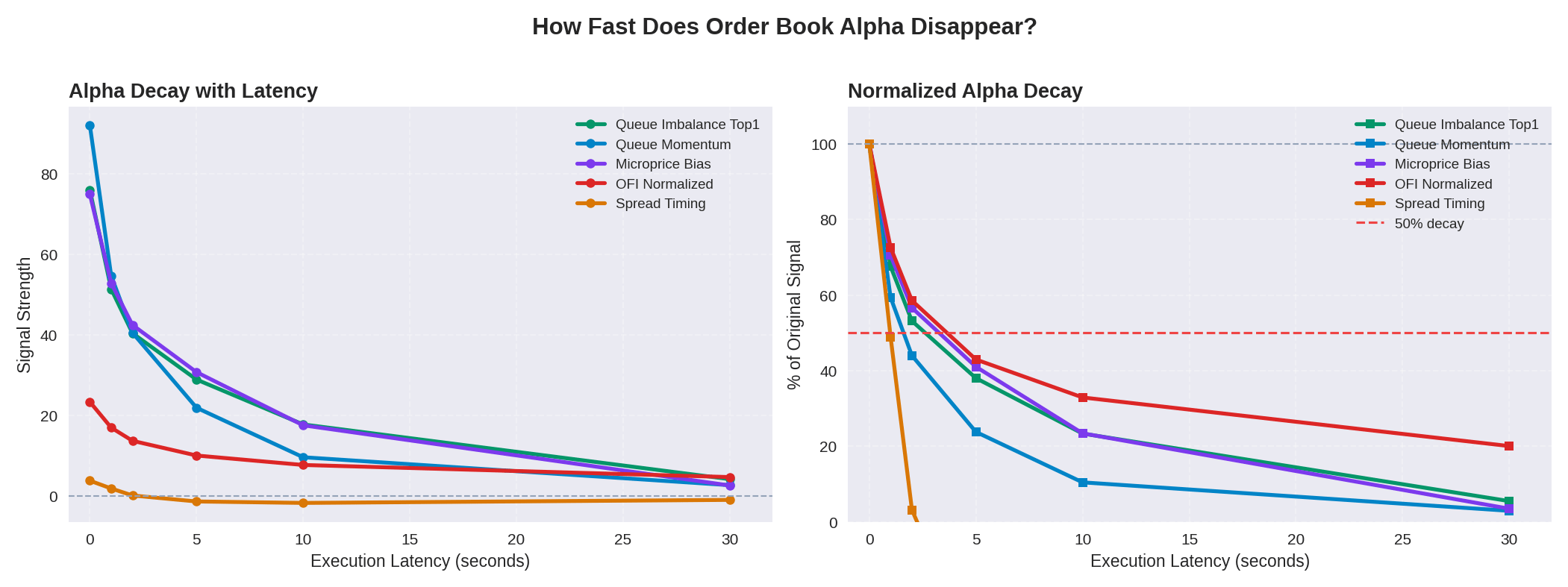

We evaluate each signal's Sharpe ratio at execution latencies from 0 to 30 seconds. The results are striking:
Queue Momentum is the most latency-sensitive: Sharpe drops from 92 at 0s to 10 at 10s. Its half-life is roughly 2 seconds.
Imbalance signals (Top1, Top5, Microprice Bias) lose about half their value by 5 seconds. At 30s latency, they're barely above zero.
OFI signals are more resilient — OFI Rolling 5s retains meaningful Sharpe even at 10–30s latency. This makes sense: smoothed flow signals change more slowly.
Spread Timing is the only strategy that's essentially latency-insensitive, but it also has the weakest pre-cost Sharpe.
The message is clear: this alpha is real, but it lives in the sub-10-second domain. To exploit it, you need co-located infrastructure with sub-second execution — the domain of professional HFT firms, not retail traders.
6. Cross-Asset Consistency
Do signals work uniformly or only on specific assets?
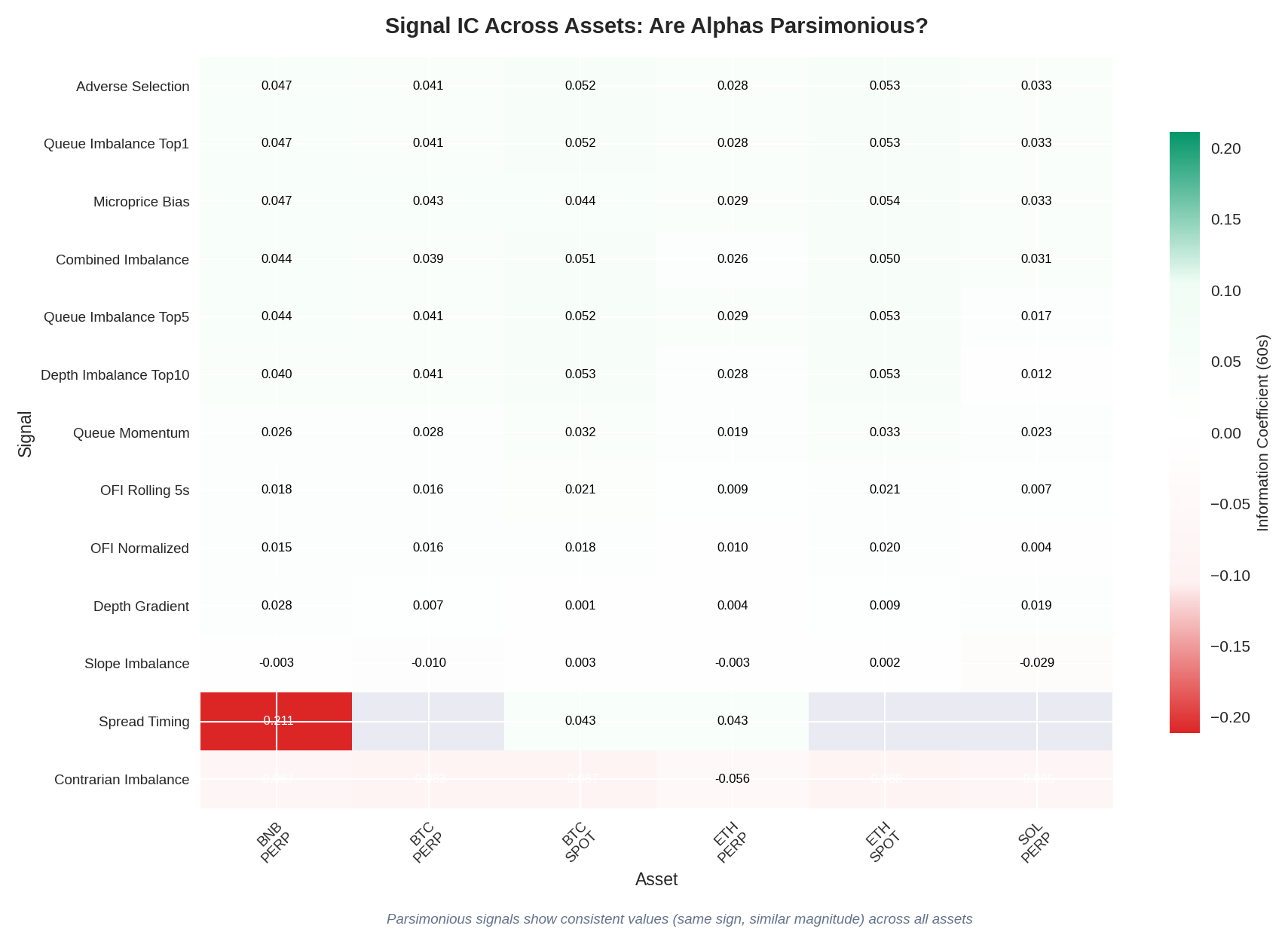
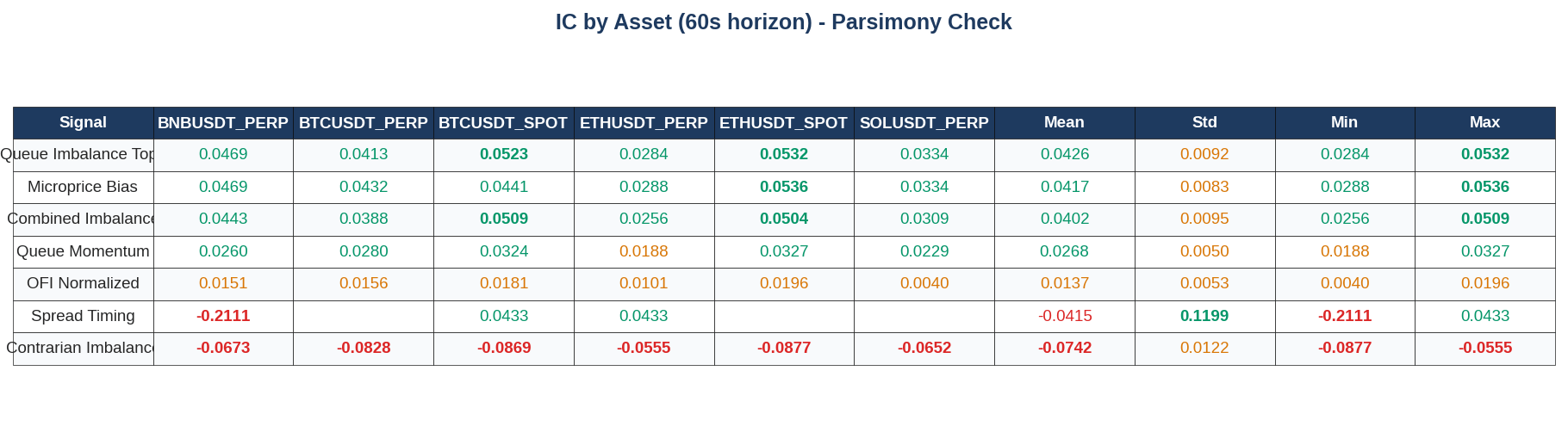
The strongest signals (Queue Imbalance, Microprice Bias) show positive IC across all 6 markets. This cross-asset consistency is important — it reduces the risk that we're overfitting to a single instrument's idiosyncrasies.
BTC and ETH perpetual futures tend to show slightly stronger IC than spot markets, consistent with the idea that derivative markets are where informed flow concentrates.
What to Take Away
The alpha is real. Order book imbalance signals have statistically significant predictive power for short-term crypto price movements. The IC values are modest (0.01–0.05) but the t-statistics are strong (3–13), and the results are consistent across assets and time.
But most of it is redundant. Of the 13 signals we tested, you can capture the vast majority of predictable variation with just 3–4: one imbalance measure (Queue Imbalance Top1 or Microprice Bias), one flow measure (OFI), Queue Momentum, and optionally a spread filter.
The alpha decays fast. Most signals lose 50% of their predictive power within 5 seconds of latency. At 30 seconds, nearly all of it is gone. This is not alpha you can capture by placing orders on a web interface.
Mean reversion doesn't work. The Contrarian Imbalance signal — fading extreme book imbalances — has consistently negative IC. When the book is lopsided, the price moves with the imbalance, not against it.
The signals are features, not strategies. No single binary signal here is tradeable after realistic costs (5+ bps round trip). But as inputs to a multi-factor model with smarter entry/exit logic, position sizing, and execution optimization, they contain genuinely useful information.
This is how quant firms use microstructure data: not as standalone trading rules, but as predictive features in a machine learning pipeline that combines multiple weak signals into one stronger one.
Methodology Notes
Forward returns: log(mid_{{t+h}}) − log(mid_t), expressed in basis points
IC: Pearson correlation between signal value and forward return
Rank IC: Spearman rank correlation
t-statistic: IC / (std(IC across assets) / sqrt(N_assets))
All signals computed from Level 2 order book snapshots, resampled to 1-second bars
No look-ahead bias: signals use only data available at time t; forward returns are computed from t+1 onward
For educational purposes only. Not investment advice. Past predictive relationships do not guarantee future results.
Related Articles
5 HFT Secrets Every Quant Trader Should Know — Practical insights from high-frequency trading research
Crypto - Price Action Alpha Report - Jan 2026 — Data-driven analysis of cryptocurrency price patterns
Building a Market-Maker on Hyperliquid — Part III: The Backtester — Building and backtesting a crypto market-making engine