
Alpha Combinations, Part 1: The Maths of Blending Signals
Closed-form Sharpe prediction, pairwise correlation structure, and the efficient frontier of alpha pairs

The Alpha Atlas tested 12 alphas individually. But nobody trades a single alpha. The real question is: how do you combine them?
There is a formula. It takes three numbers, two Sharpe ratios and a correlation, and returns the best possible combined Sharpe. No optimiser, no fitting, no data beyond those three inputs. Tested on 330 real alpha pairs, it predicts the actual combined Sharpe with R² = 0.95. This post derives it, explores its edge cases, and shows what it looks like in practice.
The Formula
Two alphas. Sharpe ratios S₁ and S₂. Correlation ρ. The maximum achievable Sharpe of any combination:
S_p* = sqrt((S1² + S2² - 2ρ·S1·S2) / (1 - ρ²))
This is the tangency portfolio Sharpe from Grinold & Kahn, Active Portfolio Management, 2nd ed. (McGraw-Hill, 2000), Section 14.3. It assumes jointly Gaussian returns with stationary correlation.
The word maximum matters. This Sharpe requires the optimal weight on each alpha. At any other allocation the realised Sharpe is lower. The general formula for weight w on alpha 2:
S_p(w) = ((1-w)·S₁ + w·S₂) / √((1-w)² + w² + 2w(1-w)ρ)
At equal weight (w = 0.5):
S_eq = (S₁ + S₂) / √(2(1 + ρ))
S_p* is the ceiling. S_eq is what you get with no weight estimation. The gap between them is the cost of not optimising.
What the Formula Tells You
Case 1: ρ = 0 (uncorrelated).
S_p = √(S₁² + S₂²)
Sharpes add in quadrature, like perpendicular vectors. Two uncorrelated alphas with S = 1 give S_p = √2 ≈ 1.41.
Case 2: ρ = 1 (perfectly correlated).
The denominator vanishes. No diversification possible. You are rescaling the same bet.
Case 3: S₁ = S₂ = S (equal Sharpes).
S_p = S · √(2 / (1 + ρ))
This is the diversification multiplier. At ρ = 0: √2. At ρ = 0.5: 1.15×. At our empirical average ρ = 0.46: 1.17×. Correlation eats the multiplier fast.
The Weights
The optimal weights (equal volatility):
w₁* = (S₁ − ρ·S₂) / ((S₁ + S₂)(1 − ρ))
w₂* = 1 − w₁* = (S₂ − ρ·S₁) / ((S₁ + S₂)(1 − ρ))
Equal Sharpes → equal weight. w₁ = 0.5 regardless of ρ.
Stronger alpha gets more. Higher S₁ tilts the weight. At high ρ, the tilt becomes extreme.
ρ → 1 → weights explode. The denominator vanishes. Same instability as the Sharpe formula.
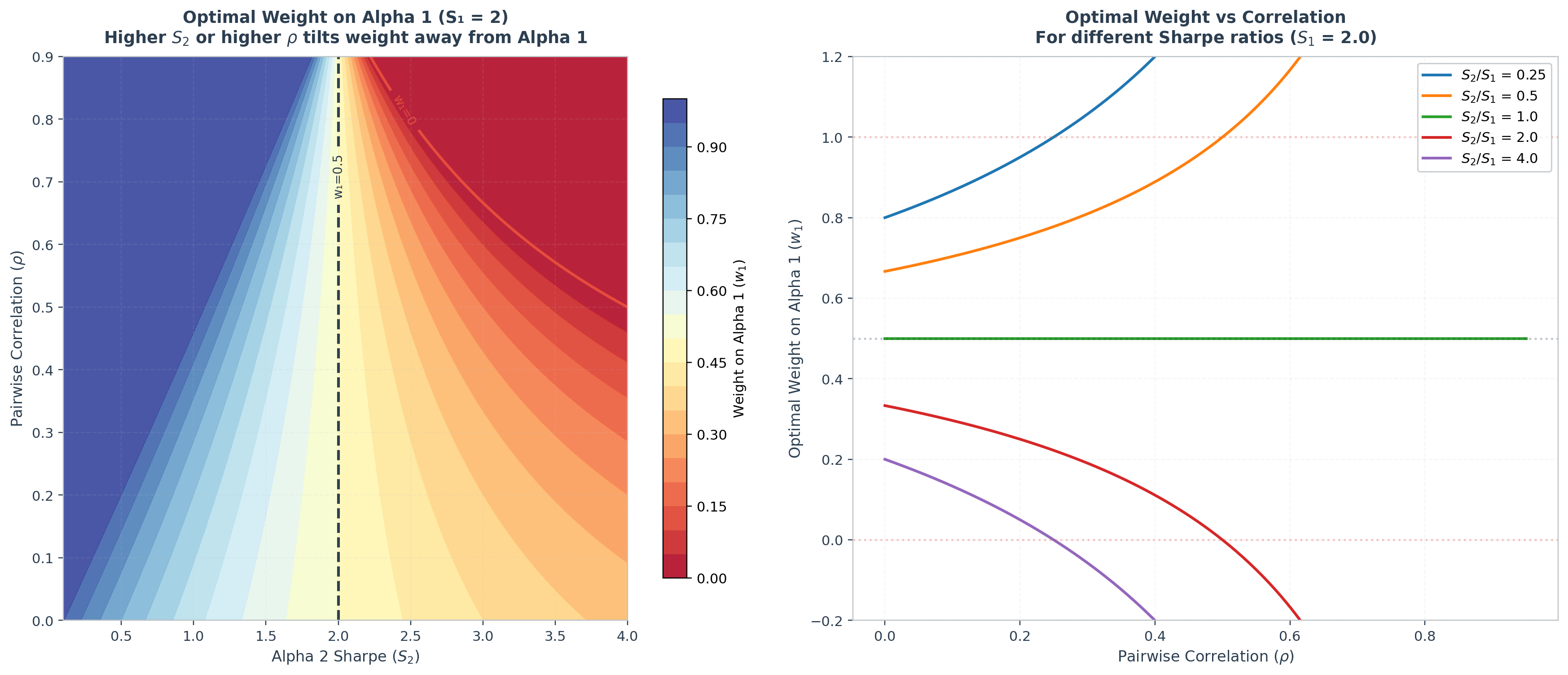
Left: weight on alpha 1 vs S₂ and ρ. Right: weight curves for different Sharpe ratios.
When Does a Second Alpha Help?
We want S_p* > S₁. Square both sides and simplify:
(S₂ − ρ·S₁)² > 0
Always true. So with optimal weights:
Add a second alpha if and only if S₂ > ρ · S₁
But with equal weights, the hurdle is stricter:
S₂ > S₁ · (√(2(1+ρ)) − 1)
At ρ = 0.5 with S₁ = 2: the optimal-weight threshold is S₂ > 1.0, but equal-weight needs S₂ > 1.45. The gap is the price of not fitting weights.
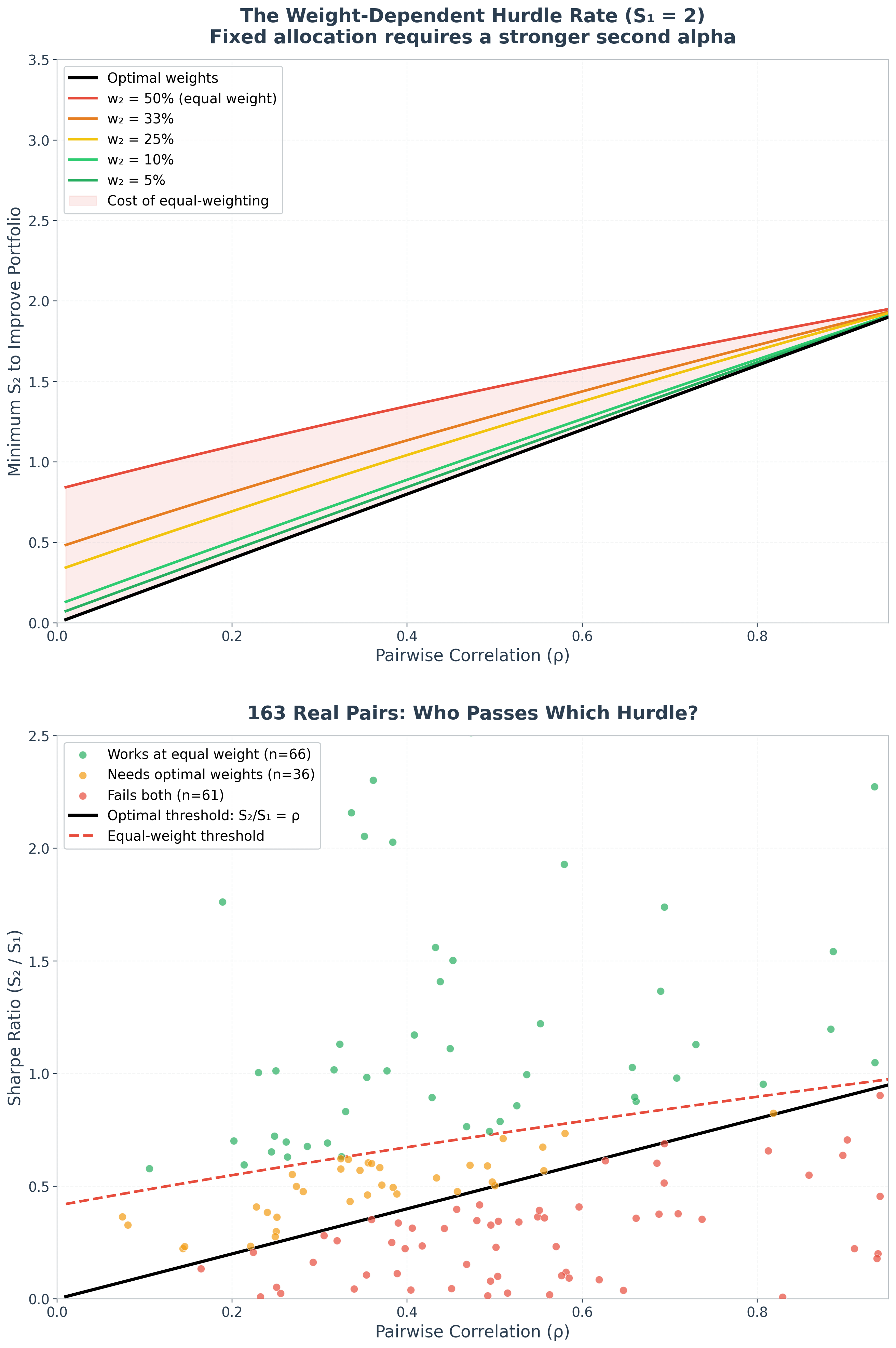
Left: minimum S₂ for different weight allocations. Right: 163 real pairs classified by which hurdle they clear.
Of our 330 alpha pairs, 163 have both alphas with positive Sharpe (the rest include at least one losing signal, where the formula does not apply). Among these 163: 40% work at equal weight. 22% need optimised weights. 37% fail both, too correlated to benefit from any combination.
When Combining Hurts
Take S₁ = 2.0, S₂ = 0.5, ρ = 0.4. The optimal combination gives S_p ≈ 2.03, barely above S₁. But at equal weights:
S_eq = (2.0 + 0.5) / √(2 × 1.4) = 1.49
Worse than alpha 1 alone. The weak, correlated signal dilutes the strong one. Don't equal-weight a strong signal with a weak, correlated one. Either optimise the weights or drop the weaker signal.
The Sharpe Surface
The formula as a contour plot. Fixed S₁ = 2, varying S₂ and ρ. The dashed line is the break-even boundary S₂ = ρ·S₁. Scatter: 330 real alpha pairs.
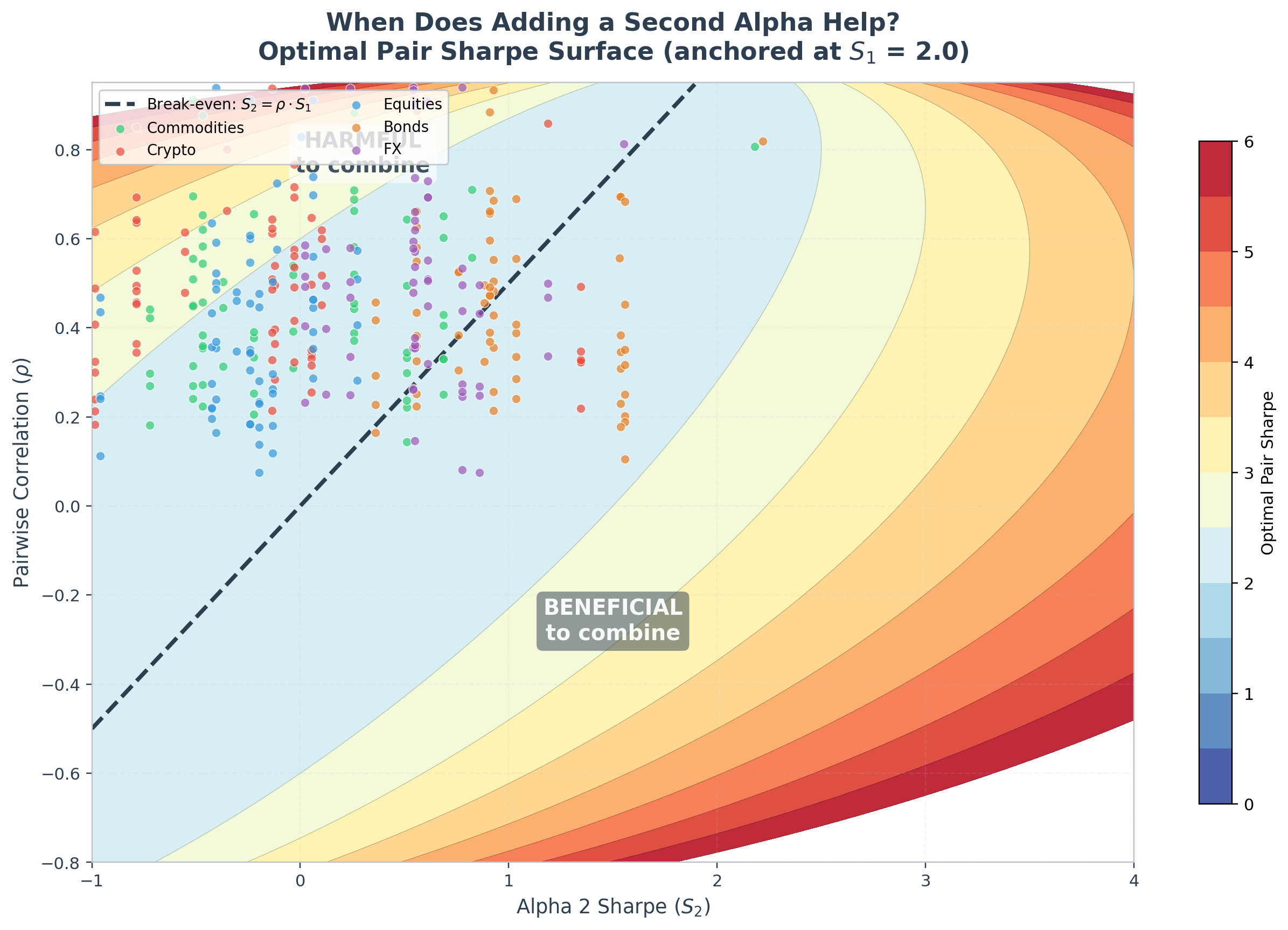
149 of 330 pairs (45%) land in the beneficial region. The rest are within-family pairs where ρ is too high.
From 2 to N
For N equal-weight alphas with average correlation ρ̄:
S_p = S · √(N / (1 + (N-1)ρ̄))
N → ∞: S_p → S / √ρ̄. With ρ̄ = 0.46, the ceiling is 1.47×S.
N = 12 (our setup): S_p ≈ 1.41×S. Already 96% of the ceiling.
More signals of the same type won't help. The path to higher Sharpe runs through lower correlations, genuinely different signal families.
Does It Work?
163 pairs where both alphas have positive Sharpe. Closed-form prediction vs actual Sharpe from fitting optimal weights on the full dataset:
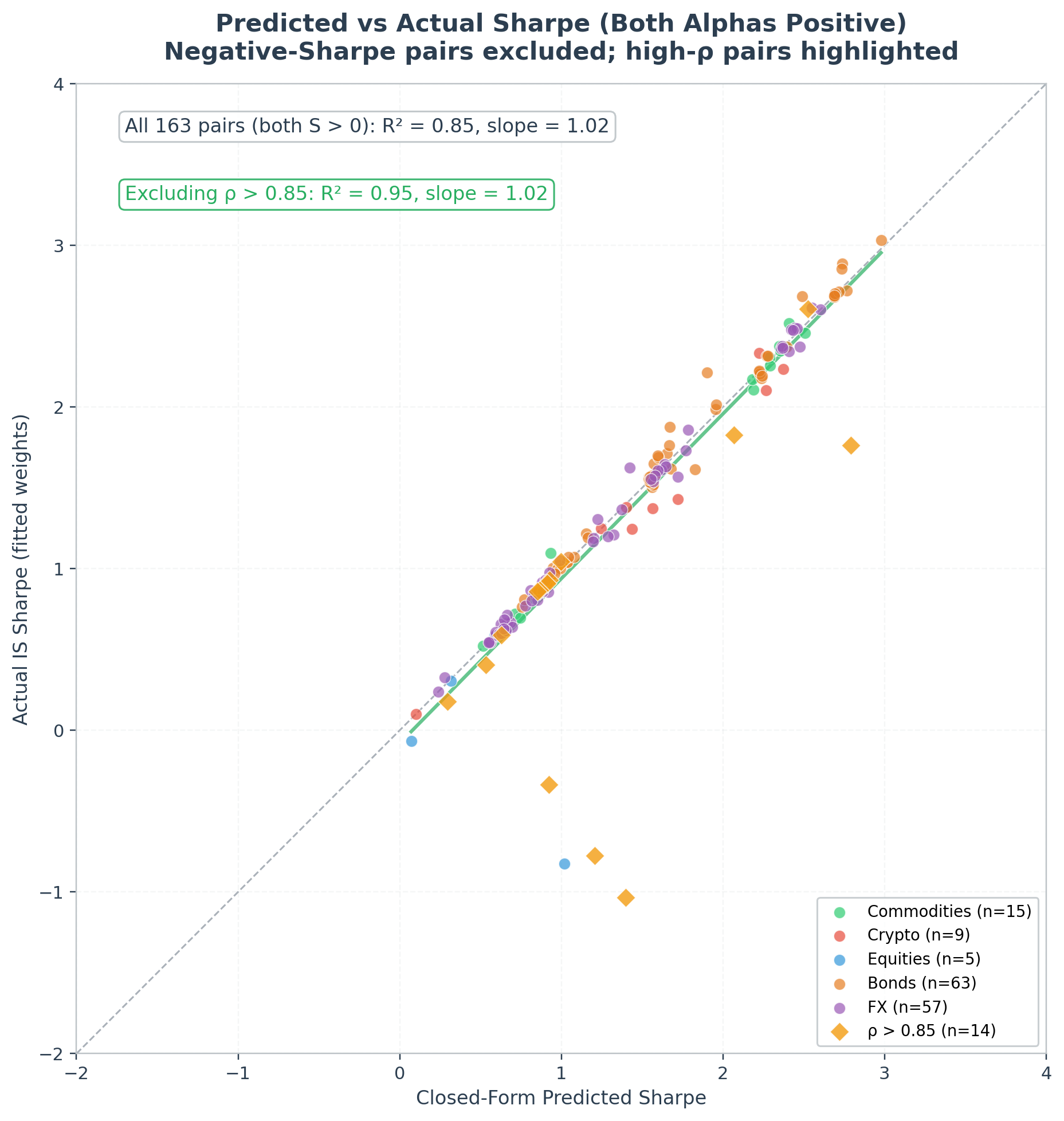
R² = 0.85. Excluding 14 pairs with ρ > 0.85 (orange diamonds): R² = 0.95. The formula works. The failures are identifiable: high correlation amplifies estimation noise in the denominator (1 − ρ²).
Greedy Selection
Start with the best single alpha. At each step, add whichever remaining alpha maximises the closed-form portfolio Sharpe. No fitting, just the formula and the correlation matrix.
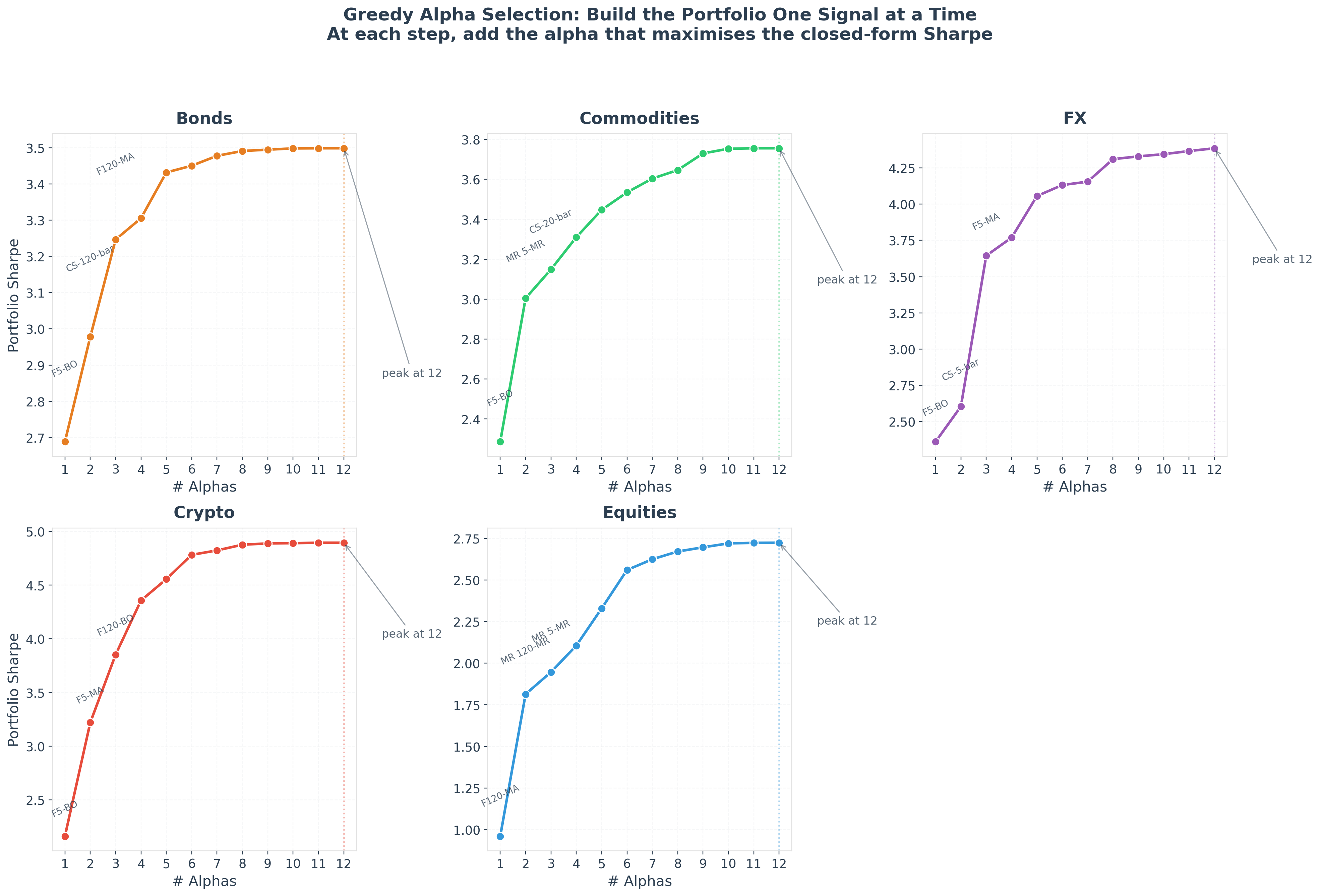
Each panel: one asset class. The first 3–4 additions drive most of the improvement.
4 to 6 alphas capture 90%+ of the achievable Sharpe.
The algorithm alternates across families, breakout, then mean-reversion, then momentum, to maximise diversification at each step.
Some asset classes peak before 12. Adding the 8th or 9th alpha lowers Sharpe. Destructive interference in action.
The Correlation Matrix
Everything above depends on ρ. Here it is for all 12 alphas across 5 asset classes (March 2022 to February 2026):
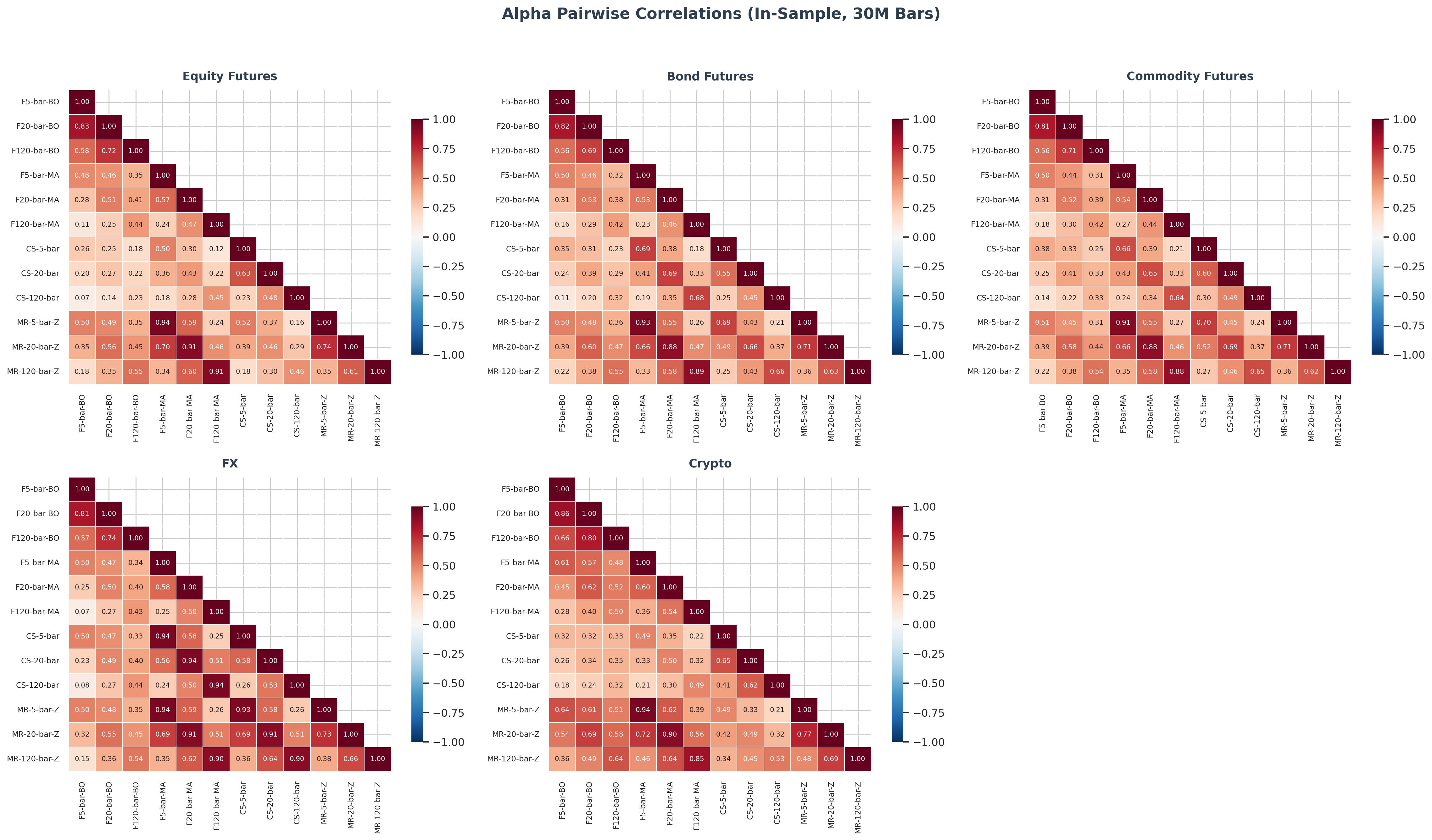
Within-family: 0.6 to 0.9. Breakout lookbacks measure the same thing at different speeds. Limited diversification.
Cross-family: 0.2 to 0.5. Breakout vs mean-reversion is where the diversification lives.
Average ρ̄ = 0.46. Plugging into the N-asset formula confirms the 1.47× ceiling.